Download

1 / 18
180 likes | 295 Views
This exploration of Manifest Destiny highlights its roots in religious belief and the rise of the Church of Latter-Day Saints, founded by Joseph Smith. It discusses the political climate of the early 19th century, including the Missouri Compromise of 1820, which sought to maintain a balance between free and slave states. As westward expansion intensified, fueled by the Gold Rush and the desire for new land, tensions over slavery emerged, ultimately contributing to the sectional divides leading to the Civil War.

E N D
Religion and Philosophy • Religious change • Mormon Church (1830) • Church of Latter Day Saints • Joseph Smith • Brigham Young
Brigham Young Founder: -Salt Lake City -University -Leader of LDS
“Balance of Power” • 11 Free/11 Slave States • South desired slavery in new states • Feared losing balance and a constitutional amendment outlawing slavery
The Missouri Compromise (1820) • 2 states enter the union • Maine (Free State) and Missouri (Slave State) • Maintains Balance of Power • No new slave states above Missouri’s southern border
Sectional Differences Emerge Missouri Territory applies for statehood Why is this a problem? There are an equal number of slave/free states, Missouri would tip the balance Henry Clay – Missouri Compromise (1820) Missouri = slave Maine = free (split from Massachusetts) 36-30 line: north= free, south = slave
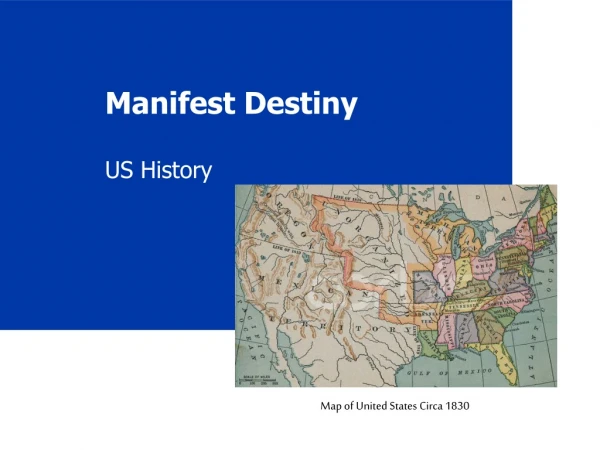
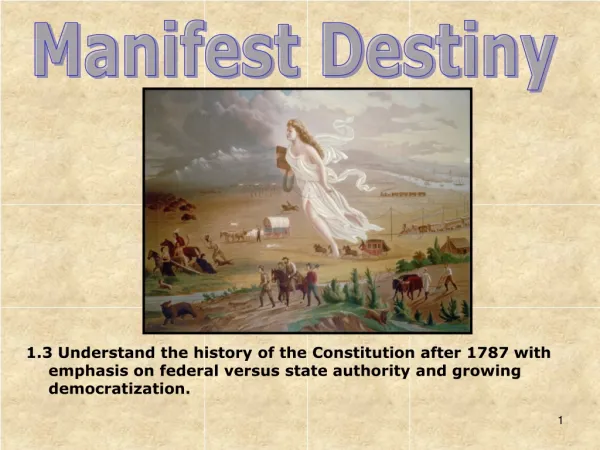
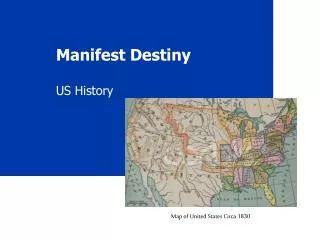
Manifest Destiny • Belief that America should expand to the West • WHY? • “Sea to shining sea” • Slavery could expand • Space for immigrants • New Markets • Cheap land
Other Reasons for Westward Expansion: • Escape religious persecution • Find new markets for trade • Claim land for farming, ranching, and mining • Locate Pacific harbors • Spread American culture and ideals
John O’ Sullivan “…(it is) our manifest destiny to overspread the continent allotted by Providence for the free development of our yearly multiplying millions”
The Great Migration of 1843 (“Wagon Train of 1843”)Oregon Trail
“The Oregon Trail” • Up to 1000 settlers (1843) • By 1891 more than 400,000 will make the journey • 15,000 die (1842-1891) • Journey took 4-6 months or longer • 2000 miles in distance (St. Louis to Oregon Country)
The “Gold Rush” • Gold is discovered in the California territory • 49ers
The California Gold Rush • What was it? • Mass migration to California after the discovery of gold in 1848 • Who was involved? • “49ers” = Gold Rush miners • Where did they come from? • Across the US & other Pacific Rim nations (South America, China)
The California Gold Rush - Effects • Conditions of the camps • Crowded, poor sanitation, violence • Population boom of… • San Francisco • Groups facing discrimination • Indians, Chinese, & Mexicans; taxed, terrorized
The California Gold Rush - Effects • ____________ applies for statehood… • California • Increases the debate over… • Slavery • 15 free states, 15 slave • Would later lead to the… • Civil War