Plant and Animal Circulation: Processes and Systems Explained
This article dives into the circulatory systems of plants and animals, comparing open and closed systems. It explains how specialized vascular tissues, xylem and phloem, facilitate water and sugar movement in plants through mechanisms like cohesion, adhesion, and the pressure flow hypothesis. Additionally, the article outlines the components of the human cardiovascular system, including the heart's anatomy and the flow of blood. It highlights factors that maintain healthy blood pressure and examines lymph composition and clot formation, providing a comprehensive overview of circulation in biological systems.

Plant and Animal Circulation: Processes and Systems Explained
E N D
Presentation Transcript
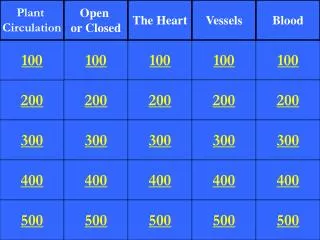
Plant Circulation Open or Closed The Heart Vessels Blood 100 100 100 100 100 200 200 200 200 200 300 300 300 300 300 400 400 400 400 400 500 500 500 500 500
Explain the processes the allows for the movement of water in plants.
Cohesion-of water molecules pulls the water molecules togetherAdhesion allows the water molecules to stick to the vessels.
Pressure flow hypothesis-dissolved sugars move through the phloem from sources (high concentration) to sinks (low concentration)
Water in the soil moves via osmosis into root hairs (large surface areas) to the xylem vessels in the roots to stem xylem to leaf to photosynthesizing cells to the atmosphere
Type of circulatory system in which the composition of the fluid surrounding is the same as the fluid being transported?
Type of system that exchanges nutrients between fluids and cells
Describe the 3 components of the closed cardiovascular system
Heart:artia-receive the bloodventricle pump the bloodBlood Vessels:Arteries-carry blood away from the heartVeins-carry blood towards the heartCapillaries- very small allow for exchange of substancesBlood: Carries the substances
Two proteins that control the molecular motor of the heart muscle
Vena cava-Right atria-right ventricle-pulmonary artery-lungs-pulmonary vein-left artia-left ventricle-aorta
Movement of blood in the veins is helped by pressure from the __
Complex interaction involving hormones, nervous, excretory and circulatory systems. Nerves connect pressure receptors in the aorta and the artery leading to the head to cardiac-control centers in the brain. Emotions, and chemical input, especially carbon dioxide concentration all effect BP