Download
1 / 12
120 likes | 230 Views
This lecture covers fundamental concepts in computer organization and design, focusing on instruction sets, CPU control, and datapath components. Key topics include the classic components of a computer, the address bus, memory architecture (RAM and hard disk), and input/output devices. It also delves into assembly language for MIPS, demonstrating instruction encoding, use of CPU registers, the program counter, and stack pointers. The course emphasizes the power of computing through decision-making (if statements) and iteration (loops).

E N D
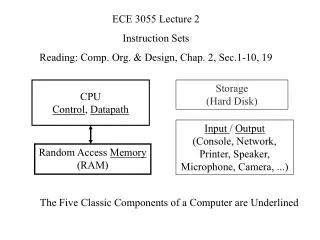
ECE 3055 Lecture 2 Instruction Sets Reading: Comp. Org. & Design, Chap. 2, Sec.1-10, 19 CPU Control, Datapath Storage (Hard Disk) Input / Output (Console, Network, Printer, Speaker, Microphone, Camera, ...) Random Access Memory (RAM) The Five Classic Components of a Computer are Underlined
Address Bus, A0-A31 32-lines (addr bits) Memory Chip or Array of Chips Read/Write (R/W) Data (In or Out) No of Bytes = 2^(addr bits) = 4,294,967,296 for 32 address bits CPU Registers - Ptrs to Memory Locations Program Counter (PC) Stack Pointer (SP) Index Pointer (IP) (+ Offset ) 10980 - Program . . . 16864 - Stack, Bottom . . . 24896 - Data . . . 28164 - End of Allocation 2
Instruction Set Architecture - Must Match CPU Architecture C code: X = Y + Z ; Assembly (for MIPS): lw $8, Y lw $9, Z add $10, $8, $9 sw $10, X Machine Language (for MIPS, “add $10, $8, $9”): 000000 01000 01001 01010 00000 100000 In decimal: op=0, rs=8, rt=9, rd=10, shamt=0, addr/funct=32 MIPS is a RISC. All machine instructions are 32-bits long. 3
Instruction Buffer op rs rt rd shamt addr/function 6 5 5 5 5 6 bits . Register 1 Register 2 ALU (Arithmetic & Logic Unit Register 3 Register 4 * * * Register 30 4
C Program Compiler Assembly Language Program Assembler Machine Language Program Linker/ Loader Hard Disk Memory, PC = Program 0, Run 5 2-4
The Power of Computing comes from Decisions (if’s) and Iteration (loops and arrays) C-code: Loop: g = g + A[i] ; // add all A[i] values to g i = i + j ; if ( i != h) goto Loop ; Assembly: Loop: multi $9, $19, $10 # $19 = i, $10 = 4 lw $8, Astart($9) # $8 -> A (=&A[0]) add $17, $17, $8 # g = g + A[i] add $19, $19, $20 # i = i + j bne $19, $18, Loop # branch on i != h To branch on >, <, <= ,or >= requires two assembler instructions: slt $1, $16, $17 # $1 = 1 if $16 < $17, 0 if $16 >= $17 bne $1, $0 # branch if $1 != 0 (if $16 < $17) 6 2-5
Machine Language Procedure A Machine Language Procedure B Machine Language Procedure C Linker Machine Language Procedure D Machine Language Program 0: Procedure A 64: Procedure B 112: Procedure C 176: Procedure D 7
Procedure A calls a Procedure “B” (Subroutine B() in C): A executes: “jal ProcedureAddress” “jal” stores next instruction address (PC + 1) on $31 sets Instruction Addr Reg.(Program Counter) = ProcedureAddress Procedure B starts running must store value of $31 before it gets overwritten (“callee save”) must store values of any other registers before using them, except those to be used for return values. does its job (e.g., I/O, sorts data in memory, puts Pi in $2, ...) restores register values to the way A left them, including $31 executes: “jr $31” “jr” resets IAR (PC) to value of $31 Procedure A then starts running again, exactly where it left off, except some registers have values returned from B, and/or data values in memory may have changed. 8
Other Addressing Modes Immediate: Constant value included in the last 16 bits of Instruction Add 4 to $29 Assembler: addi $29, $29, 4 # add 4 to $29 Machine: op (6 bits) =8, rs (5 bits) = 26, rt (5 b) = 26, immed.(16b) = 4 001000 11010 11010 11010 0000000000000100 Branch if $18 < 10 Assembler: slti $8, $18, 10 # set $8 to 1 if $18 < 10 bne $8, $0, Label # branch to Label if $8 != 0 bne $1, $0 # branch if $1 != 0 (if $16 < $17) 9
Unconditional Jump Assembly: j 10000 # jump to location 10000 Machine: op (6 bits) = 2, address (26 bits) = 10000 000010 0000000000010011100010000 jump address is relative to PC+4 (the next normal instruction address) note: 2^25-1 = +/- 33,554,431 - maximum jump distance Conditional Jump Assembly: beq $21, $8 Exit # jump to “Exit” if $21 == $8 Machine: op (6 bits) = 5, rs (6) = 21, rt (6) = 8, address (16 b) = “Exit” note: 2^15-1 = +/-32,767 - max. single-instruction jump distance. Longer Jump: bnei $18, $19, 4 # jump over next instr. if $18 != $19 j Exit # now Exit can be 33MB distant. 10
MIPS is a “RISC”- Reduced Instruction Set Computer All instructions are the same length (short). Instructions execute quickly. More instructions needed - larger memory required. “CISC”- Classical Instruction Set Computer Instructions vary in length (2, 4, 6, 8 bytes) Instructions execution time varies, some are slow Less instructions needed - smaller memory required Example of instructions not in MIPS’s Instruction Set: Increment X (no INCR, no direct operation on memory locations Increment, compare, and branch ( if (++i < $12) goto Label) Copy 1000 bytes from memory address X to memory address Y) 12