Understanding Electric Circuits: Key Elements, Laws, and Circuit Types
340 likes | 443 Views
This comprehensive guide explores the fundamental concepts of electric circuits, including the three essential elements: conductors, potential difference, and closed loops. It delves into crucial topics like Ohm's Law, which connects voltage, current, and resistance, alongside the units of measurement. Additionally, it covers various circuit configurations—series and parallel—highlighting their differences and respective electrical laws. Readers will also learn to calculate resistance and electrical power, equipping them with the tools to analyze and understand circuit behaviors effectively.


Understanding Electric Circuits: Key Elements, Laws, and Circuit Types
E N D
Presentation Transcript
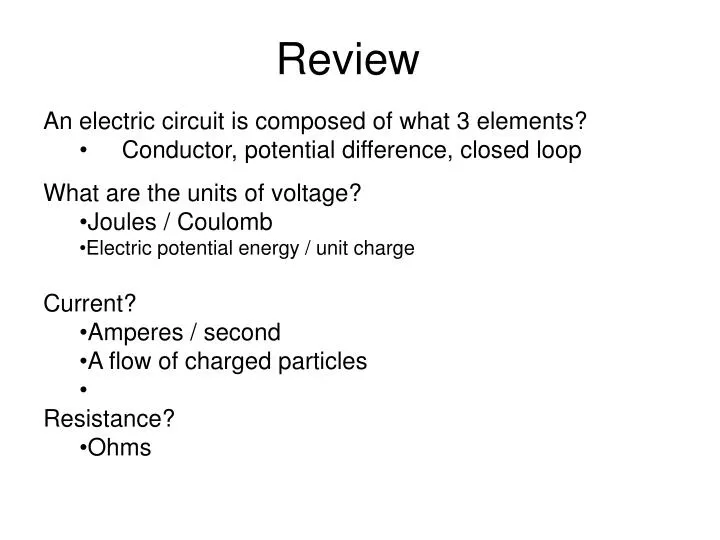
Review • An electric circuit is composed of what 3 elements? • Conductor, potential difference, closed loop • What are the units of voltage? • Joules / Coulomb • Electric potential energy / unit charge • Current? • Amperes / second • A flow of charged particles • Resistance? • Ohms
Current • Electric current is the rate of flow of charge • I = Δq/ Δt • Ampere = Coulomb per second (passing by a point in a circuit)
Ohm’s Law: Ohm's Law …says that, for many materials under a wide range of conditions, the voltage, V, and current, I, are linearly related, which implies resistance, R, is independent of V and I.
Ohm’s Law: Ohm's Law …says that, for many materials under a wide range of conditions, the voltage, V, and current, I, are linearly related, which implies resistance, R, is independent of V and I. When does it not apply? (Most important case) • Changing Temperature
Questions What is the effect on the current through a system if the voltage is doubled? Resistance doubled? Both? A device connected to a 1.5V battery conducts a drives a 45x10-6 A current, while the same device connected to a 3V battery conducts a 90x10-3 A current. Is the device ohmic?
Electrical Power • Power is the rate at which work is done or energy is expended. • Unit is Watt = Joule / second • (James Watt worked on steam engines and launched the industrial revolution) • Power = Work / time • Electrical Energy = Power * Time = IV * t
Electrical Power • P= IV “Poison Ivy”
Electrical Power • P= IV = I2R = V2/R
Electrical Power • Electrical Power is priced in kWh • One kiloWatt = 1000 Watts • One kWh = One kW for one hour
Find Resistance of a material • Depends on four factors • R ∞ Temp • R ∞ RHO (ρ) resitivity • R ∞ Length • R ∞ A-1 (cross-sectional Area)
Low resistance • Short • Fat • cold
High Resistance • Long • Thin • Hot
Kirchoff’s Junction Rule • Conservation of charge
Kirchoff’s Loop Rule • Conservation of Energy • The sum of the changes in potential around any closed path (loop) of a circuit must be zero. A A V + R1 R2
Series Circuit • Current : One path for the flow of charge • It=I1=I2=I3 • Resistance must increase because length increases • Rt-=R1+R2+R3 • Voltage must add to Zero • Vt-V1-V2-V3=0 Vt=V1+V2+V3
Series and Parallel Circuits • What does it mean to go in series? • Single file • What does it mean to go in parallel? • Multiple paths
Series Circuit: • ammeters are always in the circuit, they measure flow of charge • Ammeters should always have low resistance • Otherwise they will affect the measurement by adding resistance A A V + R1 R2
IT + VT V V Series Circuit Example R1 V1, I1 A A V2, I2 V V R2 V V Given: Vt= 10V R1 = 5W I2 = 1A P3 = 2W R3 V3, I3
IT + VT V V Series Circuit Example R1 V1, I1 A A V2, I2 V V R2 V V Given: Vt= 10V R1 = 5W I2 = 1A P3 = 2W R3 V3, I3
Series and Parallel Circuits L Series: Single Path, high effective resistance a L A Parallel: Multiple Paths, low effective resistance
Parallel Circuit • More than one path for the flow of charge • More room for the flow of charge so Resistance goes down • Voltage must stay the same since all charges have the same drop
Parallel Circuit: • Voltmeters are parallel to the circuit, they measure the potential • Voltmeters should always have high resistance • Otherwise they will allow current to flow through them and reduce effective resistance IT = I1 + I2 + I3 by Conservation of charge (conservation of matter) A IT IT A I2 + I3 I1 R3 R1 R2 V1 V2 V3 V V V V V V IT
Parallel Equations • It = I1 + I2 + I3 + … So • It/Vt = I1/Vt + I2/Vt + I3/Vt … But • Vt = V1 = V2 = V3 =, implying • It/Vt = I1/V1 + I2/V2 + I3/V3 … Or, by Ohm’s law, • 1/Rt = 1/R1 + 1/R2 + 1/R3 + …
Parallel Circuit: • Follow the current • If R1 > R2 > R3, what will the relationship between I1, I2, and I3 be? V1, V2, V3? A IT A V2, I2 V3, I3 V1, I1 R3 R1 R2 IT Circuit 1
Parallel Circuit: • Given I1 = 3A, R1= 3A, P2 = 18W, and R3 = 2W, find the other values associated with this circuit. A VT V2, I2 V3, I3 V1, I1 R3 R1 R2 IT
Parallel Circuit: • Given I1 = 3A, R1= 3A, P2 = 18W, and R3 = 2W, find the other values associated with this circuit. A VT V2, I2 V3, I3 V1, I1 R3 R1 R2 IT
Series Circuit Example: Voltage Divider IT A A Given: Vt= 24V Choose values of R1 and R2 to produce 20V across R2 + VT V1, I1 V V R1 V2, I2 V V R2
Series Circuit Example: Voltage Divider IT A A Given: Vt= 24V Choose values of R1 and R2 to produce 20V across R2 + VT V1, I1 V V R1 V2, I2 V V R2
Series / Parallel Circuit: • Given V4=12, I1 = 3A, R2= 2, R3=3, P3 = 18W. Find the other values. V4, I4 A R4 VT V2, I2 V3, I3 V1, I1 R3 R2 R1 IT
Series / Parallel Circuit: • Given V4=12, I1 = 3A, R2= 2, R3=3, P3 = 18W. Find the other values. V4, I4 A R4 VT V2, I2 V3, I3 V1, I1 R3 R2 R1 IT