Download
1 / 11
110 likes | 196 Views
Explore the potential of collaborative Web2.0 technologies in harmonizing immigration policies by meeting stakeholders' diverse requirements. Analyze and address the demands of migrants, policymakers, civil society, and more to foster inclusive decision-making.

E N D
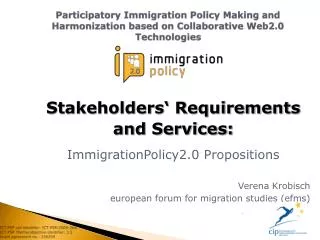
Participatory Immigration Policy Making and Harmonization based on Collaborative Web2.0 Technologies Stakeholders‘ Requirements and Services: ImmigrationPolicy2.0 Propositions Verena Krobisch european forum for migration studies (efms) ICT PSP call identifier: ICT-PSP/2009-3bis ICT PSP Theme/objective identifier: 3.5 Grant agreement no.: 256209
Agenda • Concepts (stakeholder, migration policy, economic immigration) • Stakeholders’ requirements • Conclusion
Concepts (1/2) Stakeholder of the IMP2.0 Project Demand Analysis’ Stakeholder Definition Migrants Welfare organisations IMP 2.0 Policy-Makers Migrant organisations Public Administrators ...and all other persons or institutions with an interest or concern in migration policy Experts from Civil Society 3
Concepts (2/2) • Migration Policy: Immigration policies & Integration policies • Economic Migration: Employment, self-employment & entrepreneurship
Stakeholders‘ Requirements (1/4)Sample Q=12 Q=10; E=5 Q=10; E=4 Q= 22
Stakeholders‘ Requirements (2/4)Political Level Economic / Labour Migration Policy 1) Economic migration policy approach Cooperation tools common terms 2) Labour migration monitoring & matching means’ Cooperation tools Posting demand & supply Integration Policies 3) Exchange & development of integration policies Later
Stakeholders‘ Requirements (3/4)Practical Level Institutional cooperation 4) Internet-based structures for cooperation Services for cooperation “Guide through institutional jungle” 5) Cooperation conditions’ Processes 6) Networks Multi-level-governance structure
Stakeholders‘ Requirements (4/4)Information “Umbrella Portal” 7) Not “reinventing the wheel” • 8) Special information • EU level developments • European „Good Practices" Specialized Services -Pre-selection & summary -Institutionalized exchange
Conclusion • Potential & demand for bottom-up harmonization • Crucial task: Inclusion of users • Stakeholders’ requirements raise questions • How to realize the requirements? • What requirements should be emphasized? • What are limitations? • What else needs to be considered?
Participatory Immigration Policy Making and Harmonization based on Collaborative Web2.0 Technologies Thank you! For more information, please contact: Verena Krobisch Verena.krobisch@uni-bamberg.de +49-951-93202016 ICT PSP call identifier: ICT-PSP/2009-3bis ICT PSP Theme/objective identifier: 3.5 Grant agreement no.: 256209
Contextualizing Stakeholders’ Requirements START Conception Phase Specification Phase DemandAnalysis • Questionnaires • Expert Interviews Desk Research Workshop 11