Understanding Graphical Models: Chain Graphs and Other Semantics in Directed Graphs
This document delves into the intricacies of Graphical Models, specifically focusing on Chain Graphs and other Graphical Semantics. It provides examples illustrating the behavior of various nodes and their relationships, such as boundary (bd) and closure (cl) operations. The distinction between ancestral and non-ancestral sets is analyzed, alongside concepts such as moral graphs and triangulated graphs. The discussion aims to enhance the comprehension of how different types of graphical models represent complex relationships within data.

Understanding Graphical Models: Chain Graphs and Other Semantics in Directed Graphs
E N D
Presentation Transcript
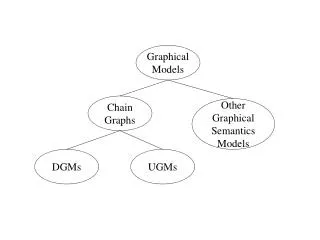
Graphical Models Chain Graphs Other Graphical Semantics Models DGMs UGMs
A B • Examples: • bd({C,D}) = {A,B} • bd({A}) = {B} • and so on… C D
A B • Examples: • bd({A}) = Ø • bd({C,D}) = {A,B} • cl({A}) = {A} • cl({D}) = {C,B,D} • and so on… C D
A B C D E
F G A E B D C
1 2 3 4 5
C A B E D F G H
{A,B,C,D} is an ancestral set. {A,B,C,D} is not an ancestral set. B E A C B D A C E D
A B C
Amoral graphs Moral graphs
Triangulated Graphs Not Triangulated Graphs
A,B,C B,C,D D,E,F
Moral Triangulated A DAG A A A B D B D B D C C C E F G E F G E F G H I H I H I
A,B,C,D B,C,D,F B,E,F D,F,G E,F,H F,G,I
A C B