Exploration & Expansion (6.1)
240 likes | 475 Views
Exploration & Expansion (6.1). 2 (a-d): The key concepts of continuity and change, cause and effect, complexity, unity and diversity over time. 3b. Investigate the historical development of and impact of major scientific and technological innovations.


Exploration & Expansion (6.1)
E N D
Presentation Transcript
Exploration & Expansion (6.1) 2 (a-d): The key concepts of continuity and change, cause and effect, complexity, unity and diversity over time. 3b. Investigate the historical development of and impact of major scientific and technological innovations.
3 G’s: “God, Glory, & Gold” • God: convert the “non-believers” (i.e. natives) to holy Catholic faith • Glory: Discover “great unknown” and become famous! • Example: Marco Polo • The Travels: account of experiences traveling to Mongol Empire in the “exotic” East
3 G’s: “God, Glory, & Gold • Gold: possibility of vast wealth • Reason: Ottoman Empire limited access to trade w/ Far East/Asia • If found new water route to Asia, one could: • 1) acquire great wealth from Spice Trade • 2) access to more precious metals & become rich!
Why Europeans Able to Explore • 1) Increased Power & Wealth within European States • Could now finance expensive explorations • Exploration attractive due to desire to continue to expand power & wealth of the State/economy • 2) New Technology • allowed for reliable navigation outside of European waters (e.g. Portuguese caravel & astrolabe)
Portuguese 1st successful European explorers – Why? • 1) Superior weaponry (i.e. guns) easily defeated competitors & gave Portugal access to markets • 2) Superior sailing abilities compared to other European countries
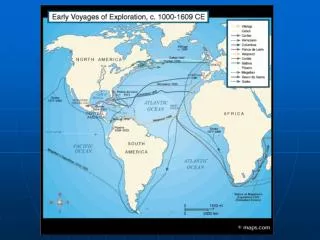
The Portuguese • Traveled along W. coast of Africa • Discovered gold in Africa (Gold coast) • Discovered water route to India via Cape of Good Hope (Dias) & acquired spices (da Gama)
Portuguese empire limited in size and power- why? • Portuguese focused on trade 1st, colonization 2nd • maintained trading posts on coasts, but didn’t venture inland to acquire more goods/trade • Result: expansion of trade limited
The Spanish • Sailed West • 1st Successful Expedition: Columbus (1492) • “Discovered” Caribbean/West Indies: landed in Cuba & Dominican Republic, but did not find water route • Significance: opened “doorway” to future Spanish exploration in Western Hemisphere
Treaty of Tordesillas • treaty b/t Spain and Portugal • Purpose: prevent the other from taking its new territory • Provisions: created line of demarcation extending N/S through Atlantic Ocean/South America • East of Line: Portuguese • West of Line: Spain
The Spanish • Conquistadors: Spanish explorers known for their use of firearms, organizational skills, and determination • Highly motivated by 3 G’s
Cortes “Conquers” the Aztec • Landed in Caribbean (Mexico) • Able to defeat Aztec by: • 1) Made alliance w/ Tlaxcala (enemy of Aztec) • 2) Took Montezuma (Aztec King) hostage • 3) Foreign disease (smallpox) killed large # of Aztec • 4) Had military superiority over Aztec
Pizarro “Conquers” the Inca • Pizarro landed on Pacific side of South America (Peru) • Able to defeat Inca b/c: • 1) Exploit Inca Civil War (war b/t kings) • 2) Superior weapons (e.g. guns) • 3) Foreign disease (Smallpox) killed large #s of Inca
Exploration efforts of the English • 1st Settled in Jamestown (VA) • Like Spanish, interested in both colonization & trade • Took control of Dutch colonies (Hudson River Valley) & virtually all of E. Coast (USA)
Exploration Efforts of the French • Like Portuguese, most interested in trade 1st, colonization 2nd • Claimed Canada & LA • Quebec: 1st permanent settlement/trading post in Americas
Impact Native Americans • 1) Enslavement • Became forced labor for Spanish (mined gold & silver + worked plantations) • 2) Dramatic decrease in population • Foreign disease (e.g. smallpox) killed millions (no immunity to diseases)
Impact on Native Americans (cont.) • 3) Loss of Culture • Missionaries arrived & converted NA + introduced European society structures (e.g. schools, hospitals, etc.)
Economic “Globalization”: The Columbian Exchange • 1) Colonists introduced plantations and ranches to raise sugar, cotton, & livestock for export to Europe • 2) Europeans introduced new food (e.g. wheat, citrus fruit) and livestock (e.g. horses) to the Americas
Economic “Globalization”: The Columbian Exchange (cont.) • 3) Food from the Americas (e.g. potatoes, corn) were sent to Europe • Impact on Europe: w/ import of food, Pop. increased rapidly (no longer limited by amt. of farmed land)