Download
1 / 17
180 likes | 311 Views
Dive into the fascinating world of waves with this comprehensive guide for 8th graders. Explore the nature of waves as disturbances that carry energy without transferring matter. Discover key concepts such as frequency, amplitude, wavelength, and speed, along with the phenomena of reflection, refraction, and diffraction. Learn to differentiate between transverse and compression waves, and understand how they interact with their environment. Ideal for supporting classroom studies in Earth Science at Blue Ridge Middle School.

E N D
Blue Ridge Middle School Wave Properties Mr. Butler Wave Properties Blue Ridge Middle School 8th Earth Science Mrs.Bright
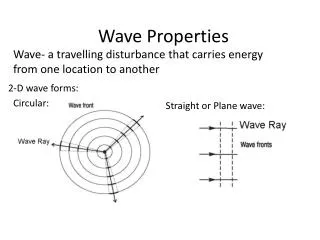
Waves • 1. A wave is a disturbance that moves through matter or space. • 2. Waves carry ENERGY NOT Matter.
Wave Diagram • http://id.mind.net/~zona/mstm/physics/waves/partsOfAWave/waveParts.htm#pictureOfAWave
Frequency • 1. Frequency is the measure of how many waves pass a point in a certain amount of time. (waves per second) • 2. The higher the frequency, the closer the waves are together AND the greater the energy carried by the waves.
Amplitude 1 • 1. Amplitude is a measure of the distance between a line through the middle of a wave and a crest or trough.
2. The greater force = the greater amplitude = the greater energy carried by the wave. • 3. In a transverse wave the higher the wave the higher the amplitude.
Amplitude 2 • 4. Sounds with greater amplitude are loud. • 5. Light with greater amplitude is bright.
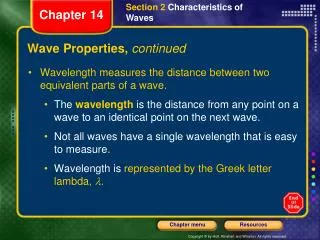
Wavelength • 1. Wavelength is a measure of the distance from crest to crest or trough to trough.
Speed • 1. Speed is a measure of the distance a wave travels in an amount of time. • 2. Speed = wavelength X frequency
Speed • 3. When a wave enters a different medium its speed changes. • 4. All EM waves travel at the SAME speed in space.
Reflection • 1. The angle of the incoming wave = the angle of the outgoing wave.
Refraction • 1. A change in the wave’s direction caused by a change in the wave’s speed.
Diffraction • 1. Diffraction is the bending of waves around an object.
FOLDABLE: Transverse Wave • 1.Causes particles to move back and forth at right angles to the direction the wave travels. • 2. High points in the waves are called crests. • 3. Low points in the waves are called troughs.
FOLDABLE: Both • 1. Both are mechanical waves. • 2. Both carry energy from one place to another. • 3. Both have the properties of wavelength, frequency, and amplitude.
FOLDABLE: Compression Wave • 1. Cause particles in matter to move back and forth along the same direction in which the wave travels. • 2. Places where the coils are squeezed together are called compressions. • 3. Places where the coils are spread apart are called rarefactions.