The Scientific Method: Understanding Frog Deformation due to UV Light Exposure
240 likes | 361 Views
This guide outlines the steps of the scientific method using the example of frog eggs and UV light exposure. It begins with observation and questioning, then moves to researching the topic and formulating hypotheses about the effects of UV light on frog development. Through experimentation, including control and experimental groups, it fosters understanding of variables. Data collection shows significant findings, leading to conclusions that confirm the hypothesis. This process highlights the critical nature of scientific inquiry and the importance of systematic experimentation.


The Scientific Method: Understanding Frog Deformation due to UV Light Exposure
E N D
Presentation Transcript
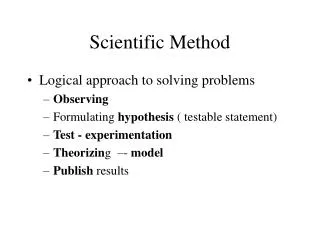
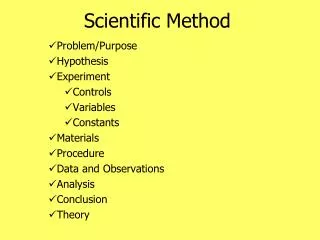
6 Steps • Step 1- Observation, Get an Idea and Ask a Question
Step 2- Research TopicFormulate Hypothesis • Frogs breath through their skin • Frogs are ultra sensitive to uv light • Frogs need to stay moist • Frog eggs do not have a hard protective coating • The hole in the ozone layer is causing more UV light to hit earth
Step 3- Hypothesis • An educated guess • It can be an if…then.. statement • Write down two hypotheses about why the frogs are deformed. • __________________________ • __________________________
Class Hypothesis • Too much UV light causes the frogs to be deformed
Step 4 and 5- Experimentation2 steps • Experiments are used by Scientists to test the hypothesis.
Experiment Steps:4. Experimental Design5. Procedure Experimental Vocabulary • Variables- the things that can affect the experiment Ex: type of eggs Amount of UV Temp. of water
Vocabulary Cont.. • Independent variable- the variable that is changed on purpose in an experiment EX: Amount of UV light • Dependent Variable- the variable, that is believed to be caused by the independent variable. • EX: Deformed frogs
Vocabulary Cont… • Control group- this is the group that provides comparison. This group is the group that is not being experimented on. • Experimental group- this is the group that is being experimented on.
Variables • Number of eggs • Amount of UV light • Temperature of environment
The UV Experiment • Experimental Group • 100 eggs • Eggs kept in a lab tank at 30 degrees Celsius • 12 hours of UV light Control Group • 100 Frog eggs • Eggs kept in a lab tank at 30 degrees Celsius • No UV light
Experimental Procedure • Materials Needed Aquarium for Frog Eggs UV Light
Step 5- Collect Data • Data is usually in the form of numbers
Data • Control Group- 65 eggs hatched into normal developed frogs • Experimental group- 40 eggs hatched, 27 frogs seemed to look normal, while 13 frogs seemed deformed in some way.
Step 6 - Conclusion and Analysis of Data • Usually scientists create a chart or table to show data, this will show trends in the experimentation. • Reject or Accept Hypothesis
Step-6 Conclusion and Analysis of Data • The data supports the hypothesis that UV light does affect frog eggs and the frogs.