Note the 4 rules
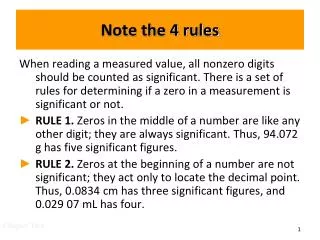
In measurement, all nonzero digits are significant, but there are specific rules for zeros. Rule 1 states that zeros in the middle of a number are always significant (e.g., 94.072 g has five significant figures). Rule 2 indicates that leading zeros are not significant; they only help in placing the decimal (e.g., 0.0834 cm has three significant figures). Rule 3 asserts that trailing zeros after a decimal point are significant (e.g., 138.200 m has six significant figures). Rule 4 notes that trailing zeros before an implied decimal may or may not be significant.

Note the 4 rules
E N D
Presentation Transcript
Chapter Two Note the 4 rules When reading a measured value, all nonzero digits should be counted as significant. There is a set of rules for determining if a zero in a measurement is significant or not. RULE 1. Zeros in the middle of a number are like any other digit; they are always significant. Thus, 94.072 g has five significant figures. RULE 2. Zeros at the beginning of a number are not significant; they act only to locate the decimal point. Thus, 0.0834 cm has three significant figures, and 0.029 07 mL has four.
Chapter Two RULE 3. Zeros at the end of a number and after the decimal point are significant. It is assumed that these zeros would not be shown unless they were significant. 138.200 m has six significant figures. If the value were known to only four significant figures, we would write 138.2 m. RULE 4. Zeros at the end of a number and before an implied decimal point may or may not be significant. We cannot tell whether they are part of the measurement or whether they act only to locate the unwritten but implied decimal point.
6 3 5 5 2 4 6 • All digits count • Leading 0’s don’t • Trailing 0’s do • 0’s count in decimal form • 0’s don’t count w/o decimal • All digits count • 0’s between digits count as well as trailing in decimal form 45.8736 .000239 .00023900 48000. 48000 3.982106 1.00040 Practice Rule #1 Zeros