Download
1 / 15
150 likes | 261 Views
This quiz reviews the principles of inelastic collisions, emphasizing changes in kinetic energy, momentum, and potential energy of objects during collisions. Momentum, defined as the product of mass and velocity, is crucial in physics, as it can be conserved under zero external forces. The quiz explores the relationship between force and momentum change (impulse), as well as practical applications, such as analyzing forces on objects like a baseball or understanding rocket motion. Engage with various questions to test your comprehension of these fundamental concepts.

E N D
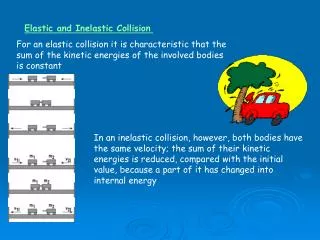
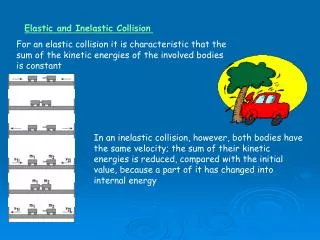
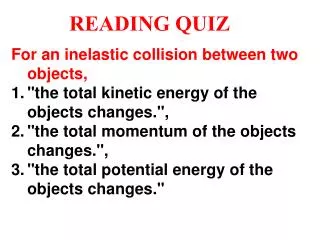
READING QUIZ For an inelastic collision between two objects, "the total kinetic energy of the objects changes.", "the total momentum of the objects changes.", "the total potential energy of the objects changes."
Momentum is a vector: Magnitude = mass times speed = mv Direction = same as velocity (To be more precise, this is the linear momentum.)
Momentum is important because it can be conserved, just like mechanical energy.
We also want to know about changes in momentum. Notation: initial momentum pi= mvi final momentum pf = mvf change in momentum Dp = pf - pi
We can rearrange F = ma to be: Dp = FDt Or, Change in momentum = Impulse. (Calculate force on baseball…)
If the net external force acting on a system of objects is zero, the total momentum of the system is conserved.
What makes a rocket move? (Is mass of rocket constant? Is air needed?)
Lecture Quiz - Question 1: Which ball experiences a greater force? Elastic Perfectly inelastic.