Elements and Compounds
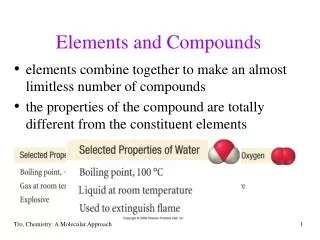
Elements and Compounds. elements combine together to make an almost limitless number of compounds the properties of the compound are totally different from the constituent elements. Chemical Bonds. compounds are made of atoms held together by chemical bonds

Elements and Compounds
E N D
Presentation Transcript
Elements and Compounds • elements combine together to make an almost limitless number of compounds • the properties of the compound are totally different from the constituent elements Tro, Chemistry: A Molecular Approach
Chemical Bonds • compounds are made of atoms held together by chemical bonds • bonds are forces of attraction between atoms Tro, Chemistry: A Molecular Approach
Bond Types • two general types of bonding between atoms found in compounds, ionic and covalent • ionic bonds result when electrons have been transferred between atoms, resulting in oppositely charged ions that attract each other • generally found when metal atoms bonded to nonmetal atoms • covalent bonds result when two atoms share some of their electrons • generally found when nonmetal atoms bonded together Tro, Chemistry: A Molecular Approach
Representing Compoundswith Chemical Formula • compounds are generally represented with a chemical formula
Types of FormulaEmpirical Formula • Empirical Formula describe the kinds of elements found in the compound and the ratio of their atoms • they do not describe how many atoms, the order of attachment, or the shape • the formulas for ionic compounds are empirical Tro, Chemistry: A Molecular Approach
Types of FormulaMolecular Formula • Molecular Formula describe the kinds of elements found in the compound and the numbers of their atoms • they do not describe the order of attachment, or the shape Tro, Chemistry: A Molecular Approach
Hydrogen Peroxide Molecular Formula = H2O2 Empirical Formula = HO Benzene Molecular Formula = C6H6 Empirical Formula = CH Glucose Molecular Formula = C6H12O6 Empirical Formula = CH2O Chemical Formulas Tro, Chemistry: A Molecular Approach
Types of Formula Tro, Chemistry: A Molecular Approach
Molecular View of Elements and Compounds Tro, Chemistry: A Molecular Approach
Classifying Materials • atomic elements = elements whose particles are single atoms • molecular elements = elements whose particles are multi-atom molecules • molecular compounds = compounds whose particles are molecules made of only nonmetals • ionic compounds = compounds whose particles are cations and anions Tro, Chemistry: A Molecular Approach
7A 7 H2 N2 O2 F2 Cl2 Br2 I2 Molecular Elements • Certain elements occur as 2 atom molecules • Rule of 7’s • Other elements occur as polyatomic molecules • P4, S8, Se8 Tro, Chemistry: A Molecular Approach
Molecular Elements Tro, Chemistry: A Molecular Approach
Ionic vs. Molecular Compounds Propane – contains individual C3H8 molecules Table salt – contains an array of Na+ ions and Cl- ions Tro, Chemistry: A Molecular Approach
Ionic Compounds • metals + nonmetals • no individual molecule units, instead have a 3-dimensional array of cations and anions made of formula units • many contain polyatomic ions • several atoms attached together in one ion Tro, Chemistry: A Molecular Approach
Writing Formulas for Ionic Compounds • Write the symbol for the metal cation and its charge • Write the symbol for the nonmetal anion and its charge • Charge (without sign) becomes subscript for other ion • Reduce subscripts to smallest whole number ratio • Check that the sum of the charges of the cation cancels the sum of the anions Tro, Chemistry: A Molecular Approach
Write the formula of a compound made from aluminum ions and oxide ions Al+3 column 3A • Write the symbol for the metal cation and its charge • Write the symbol for the nonmetal anion and its charge • Charge (without sign) becomes subscript for other ion • Reduce subscripts to smallest whole number ratio • Check that the total charge of the cations cancels the total charge of the anions O2- column 6A Al+3 O2- Al2 O3 Al = (2)∙(+3) = +6 O = (3)∙(-2) = -6 Tro, Chemistry: A Molecular Approach
Practice - What are the formulas for compounds made from the following ions? • potassium ion with a nitride ion • calcium ion with a bromide ion • aluminum ion with a sulfide ion Tro, Chemistry: A Molecular Approach
Naming Binary Ionic Compounds forMetals with Invariant Charge • Contain Metal Cation + Nonmetal Anion • Metal listed first in formula and name • name metal cation first, name nonmetal anion second • cation name is the metal name • nonmetal anion named by changing the ending on the nonmetal name to -ide Tro, Chemistry: A Molecular Approach
Name the following compounds • KCl • MgBr2 • Al2S3 Tro, Chemistry: A Molecular Approach
Naming Binary Ionic Compounds forMetals with Variable Charge • Contain Metal Cation + Nonmetal Anion • Metal listed first in formula and name • name metal cation first, name nonmetal anion second • metal cation name is the metal name followed by a Roman numeral in parentheses to indicate its charge • determine charge from anion charge • common ions Table 3.4 • nonmetal anion named by changing the ending on the nonmetal name to -ide Tro, Chemistry: A Molecular Approach
Name the following compounds • TiCl4 • PbBr2 • Fe2S3 Tro, Chemistry: A Molecular Approach
Example – Writing Formula for Binary Ionic Compounds Containing Variable Charge Metalmanganese(IV) sulfide Mn+4 • Write the symbol for the cation and its charge • Write the symbol for the anion and its charge • Charge (without sign) becomes subscript for other ion • Reduce subscripts to smallest whole number ratio • Check that the total charge of the cations cancels the total charge of the anions S2- Mn+4 S2- Mn2S4 MnS2 Mn = (1)∙(+4) = +4 S = (2)∙(-2) = -4 Tro, Chemistry: A Molecular Approach
Practice - What are the formulas for compounds made from the following ions? • copper(II) ion with a nitride ion • iron(III) ion with a bromide ion Tro, Chemistry: A Molecular Approach
Compounds Containing Polyatomic Ions • Polyatomic ions are single ions that contain more than one atom • Often identified by (ion) in formula • Name and charge of polyatomic ion do not change • Name any ionic compound by naming cation first and then anion Tro, Chemistry: A Molecular Approach
Some Common Polyatomic Ions Tro, Chemistry: A Molecular Approach
Example – Naming Ionic Compounds Containing a Polyatomic IonNa2SO4 • Identify the ions Na = Na+ because in Group 1A SO4 = SO42- a polyatomic ion • Name the cation Na+ = sodium, metal with invariant charge • Name the anion SO42- = sulfate • Write the name of the cation followed by the name of the anion sodium sulfate Tro, Chemistry: A Molecular Approach
Name the following • NH4Cl • Ca(C2H3O2)2 • Cu(NO3)2 Tro, Chemistry: A Molecular Approach
Practice - What are the formulas for compounds made from the following ions? • aluminum ion with a sulfate ion • chromium(II) with hydrogen carbonate Tro, Chemistry: A Molecular Approach
Hydrate CoCl2∙6H2O Anhydrous CoCl2 Hydrates • hydrates are ionic compounds containing a specific number of waters for each formula unit • water of hydration often “driven off” by heating • in formula, attached waters follow ∙ • CoCl2∙6H2O • in name attached waters indicated by suffix -hydrate after name of ionic compound • CoCl2∙6H2O = cobalt(II) chloride hexahydrate • CaSO4∙½H2O = calcium sulfate hemihydrate Tro, Chemistry: A Molecular Approach
Practice • What is the formula of magnesium sulfate heptahydrate? • What is the name of NiCl2•6H2O? Tro, Chemistry: A Molecular Approach
Writing Names of Binary Molecular Compounds of 2 Nonmetals • Write name of first element in formula • element furthest left and down on the Periodic Table • use the full name of the element • Writes name the second element in the formula with an -ide suffix • as if it were an anion, however, remember these compounds do not contain ions! • Use a prefix in front of each name to indicate the number of atoms • Never use the prefix mono- on the first element Tro, Chemistry: A Molecular Approach
Subscript - Prefixes • 6 = hexa- • 7 = hepta- • 8 = octa- • 9 = nona- • 10 = deca- • 1 = mono- • not used on first nonmetal • 2 = di- • 3 = tri- • 4 = tetra- • 5 = penta- • drop last “a” if name begins with vowel Tro, Chemistry: A Molecular Approach
Example – Naming Binary MolecularBF3 • Name the first element boron • Name the second element with an –ide fluorine fluoride • Add a prefix to each name to indicate the subscript monoboron, trifluoride • Write the first element with prefix, then the second element with prefix • Drop prefix mono from first element boron trifluoride Tro, Chemistry: A Molecular Approach
Name the following • NO2 • PCl5 • I2F7 Tro, Chemistry: A Molecular Approach
Write formulas for the following • dinitrogen tetroxide • sulfur hexafluoride • diarsenic trisulfide Tro, Chemistry: A Molecular Approach