Emotional Intelligence
Emotional Intelligence. Presented by the Lawyers assistance Program Facilitated by Robert Bircher. The Concept of “Intelligence”. Most people take this to mean I.Q. which is an attempt to measure cognitive capacity and functioning

Emotional Intelligence
E N D
Presentation Transcript
Emotional Intelligence Presented by the Lawyers assistance Program Facilitated by Robert Bircher
The Concept of “Intelligence” • Most people take this to mean I.Q. which is an attempt to measure cognitive capacity and functioning • The two most common I.Q. tests are the Stanford-Binet and the Wechsler adult intelligence scale, both yielding age adjusted scores with a mean of 100 and a normal range of 85-115 • While it is useful to predict who will do well at school longitudinal research reveals it is a poor predictor of life success
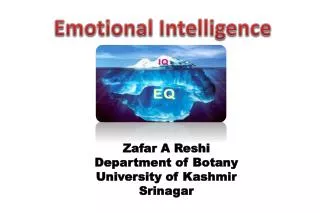
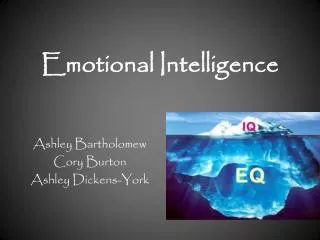
I.Q. and E.Q. • Example-an equal number of middle aged men of high and low I.Q. are chronically unemployed • There is no correlation between I.Q. and salary, productivity, or status (among college graduates) • High I.Q. is not associated with happiness in friendships, family or romantic relationships • This has stimulated interest in what other abilities are factors in a successful life
I.Q. and E.Q. • Emotional Intelligence addresses the emotional, personal, social, and survival dimensions of intelligence, which are more important for daily functioning than cognitive intelligence • Most people would call it “common sense” • Defined as “an array of personal, emotional, and social competencies that influence one’s ability to succeed in coping with environmental demands and pressures”
Components of Emotional Intelligence • See addendum #1 • There are several ways to measure Emotional Intelligence • Arguably the best test is the Bar-On EQ-I (reviewed by Buros Mental Measurement Yearbook) • Normed on about 10,000 individuals (in 15 countries and extensively studied) we will use the EQ-i:s (which is a shortened version but nonetheless very accurate)
Measuring Emotional Intelligence • Unlike I.Q. Emotional Intelligence can be changed and increases with age, gender is also a factor • The Bar-On EQ-i:s has a built in positive impression scale (to correct for overly positive responses) and validity index which checks for inconsistent responses • Provides a score for total EQ and converts raw scores to normed scores similar to I.Q. • Provides 5 subscales
Measuring EQ using the Bar-On EQ-i:S • Intrapersonal Scale-assessment of self awareness and self expression • Interpersonal Scale-assessment of social awareness and interpersonal relationship skills • Stress Management Scale-assessment of emotional management and regulation. • Adaptability Scale-Skills involved in change management • General Mood-emotional skills that fuel the self motivation needed to set and achieve goals
EQ-Interpreting results • E.Q. can be improved through training and remedial programs and therapeutic interventions • Clinical uses: • Provides a more accurate map of a persons emotional life-which is tangible and measurable like depression • Can explain why people are having a problem and what in area of their emotional life • Specifically targets whether a problem is interpersonal or intrapersonal and how adaptable they are to change
EQ-Interpreting Results • Accurately measures Stress Management Skills • Accurately measures Adaptability • Can explain lack of success (with some precision) in spite of high I.Q. which most Lawyers have • Can help in career choices, can identify problems in work and personal relationships in an objective way • High EQ is highly correlated with leadership success, academic success, and job performance
Improving EQ • Optimizing People: A practical guide for applying EQ to improve personal and organizational effectiveness-Handly(1999) • The EQ edge: Emotional Intelligence and your Success-Stein(2001) • Emotionally Intelligent Living –Orme(2001)
Steps to Completion • 1. Read instructions carefully • 2.Use ball point pen • Scoring-Read Instructions carefully • 1-26 in shaded boxes 27-51 in white boxes • Add columns A to G • F is the sum of A to E divided by 5 • Do inconsistency index • Transfer raw scores to front(male) or back(female) of Interpretive guide • Circle Normative number (SS) beside raw score • Transfer (SS) scores to pages 5,7,9,11.13,15 in interpretive guide (total EQ is on page 4) • Read interpretation