
The Cambrian and Ordovician Life: Fossils, Reefs, and Mass Extinctions
E N D
Presentation Transcript
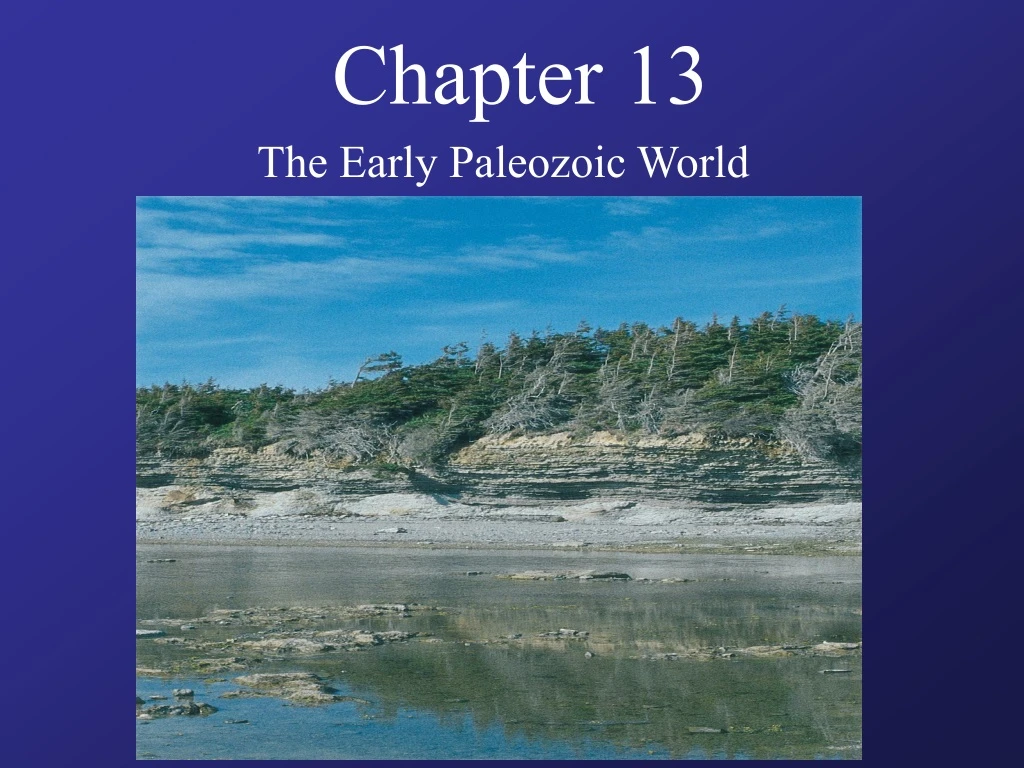
Chapter 13 The Early Paleozoic World
Guiding Questions • What kinds of animal skeletons arose during the Cambrian period? • How did Ordovician life differ from Cambrian life? • Why did stromatolites decline during Cambrian and Ordovician time? • What kind of highly successful reef community developed during the Ordovician time? • What major continental movements took place late in the Ordovician time?
444 Million years 488 Million years 542 Million years
Cambrian Explosion • Lowermost Cambrian • Simple skeletal fossils • Teeth
Cambrian Explosion • Large animals with skeletons • Trilobites • Arthropods with calcified segmented skeletons
Cambrian Explosion • Bottom-dwelling forms create scratch marks • Similar to some Neoproterozoic tracks
Cambrian Explosion • Other abundant Early Cambrian animal groups • Monoplacophoran mollusks • Inarticulate brachiopods • Echinoderms
Cambrian Explosion • Chengjiang fauna • Soft- bodied creatures including: • Cnidarians • Predatory worms • Anomalocarids • Huge carnivores (2 m) • Swimmers • Impaled prey
Cambrian Explosion • Modes of Life • Deposit feeders • Extract organic matter from sediments • Trilobites, arthropods • Suspension feeders • Collect organic matter from the water • Eocrinoids • Attach by stalk
Cambrian Explosion • Stromatolites • Less abundant; more restricted • Weak grazing pressure in inter-tidal zone
Cambrian Explosion • Reefs • Archeocyathids • Suspension feeders • Probably sponges
Cambrian Explosion • Evolutionary experimentation • Bizarre echinoderm classes • Few species and genera • Tried out many body plans
Cambrian Explosion • Middle and Late Cambrian • 15 Million year duration • Expansion of many groups • Trilobites • Echinoderns • Conodonts • Early fish • Isolated bony external plates
Cambrian Explosion • Burgess Shale Fauna • Western No. America • Deep-water setting (low O2) • Chordata • Pikaia: Notochord • Arthropods • Onychophorans • Intermediate between segmented worms and arthropods
Ordovician Life • Great radiation • Graptolites • Nautiloids • Life in sediment • Burrowers expanded • Pump oxygen-bearing water into sediment • Diversification of worms and other soft-burrowers
Ordovician Life • Life on the seafloor • Diversity of benthic organisms increased • Jawless fishes • Grazing snails • Articulate brachiopods • Crinoids expanded • Coral-strome reefs • Rugose corals • Tabulate corals • Stromatoporoids
Ordovician Life • Sediments indicate burrowers flourished
Ordovician Life • Extinctions • Large extinction events limited diversification • Cambrian mass extinctions • End of Ordovician mass extinction
Ordovician Life • Plants may have invaded land • Inconclusive evidence • Probably restricted to moist habitats
Paleogeography • Cambrian • Cratons formed supercontinent early in Cambrian • Progressive flooding of continents • Regression in Middle Cambrian and again in Late Cambrian
Ordovician Life • Transgression • Yields characteristic sedimentary pattern • Siliciclastic sediments • Innermost belt • Carbonate platform • Seaward of siliciclastics
Cambrian Events • Episodic mass extinctions • Shallow- water trilobites
Cambrian Events • Took a few thousand years each • Temporary cooling of the seas
Paleogeography • Gondwanaland nearing south pole • Glacier expanded • Sea-level fell • Mass extinction (2 pulses) • Early Ordovician • Baltica began move from South Pole • End of Ordovician • Baltica moved to tropics
Taconic Orogeny • Ordovician mountain building • Early Ordovician carbonate platform east coast of Laurentia • Mid-Ordovician carbonate deposition stopped; flysch sedimentation dominated
Taconic Orogeny • Flysch overlain by molasse • Clastic wedge tapering towards northwest
Taconic Orogeny • Carbonate platform wedged into subduction zone • Exotic terrane
Taconic Orogeny • Fossils of different fauna but same age
Taconic Orogeny • With continued collision, foreland basin migrated westward
Western Laurentian Margin • Stable continental shelf • Steep carbonate platform edge • Accumulated thick limestone sequences
Western Laurentian Margin • Burgess Shale • Unusual fauna • Collected by Walcott
Western Laurentian Margin • Buried by turbidites • Accumulated in oxygen-poor environment
Reefs Colonial reef building rugose corals
Glaciation and Mass Extinction Ordovician glaciation
Glaciation and Mass Extinction North Africa tillites
Glaciation and Mass Extinction North African glaciation