Download
1 / 2
20 likes | 129 Views
This guide explores the US Courts of Appeals, focusing on their structure and appellate jurisdiction. It addresses questions about the Supreme Court as the court of last resort, the creation of inferior courts, and the prevalence of non-federal court cases. Additionally, it distinguishes between civil and criminal cases with specific scenarios and provides examples of cases heard by the US Court of Appeals for the Armed Forces and the 12 US Courts of Appeals. Complete your understanding by assembling an 'appeal-a-mid' diagram as a visual aid.

E N D
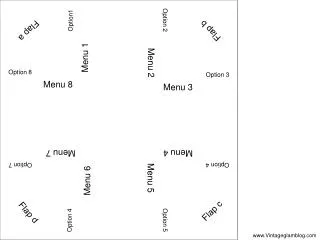
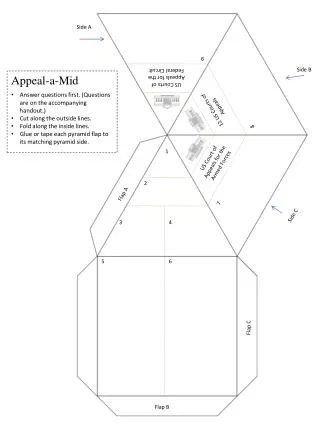
Side A 9 Side B US Courts of Appeals for the Federal Circuit 12 US Courts of Appeals Appeal-a-Mid • Answer questions first. (Questions are on the accompanying handout.) • Cut along the outside lines. • Fold along the inside lines. • Glue or tape each pyramid flap to its matching pyramid side. 8 1 US Court of Appeals for the Armed Forces 2 Flap A 7 Side C 3 4 5 6 Flap C Flap B
appeal-a-mid • Use pgs. 506-515 • Which court in the federal system is the court of last resort? (it has the final decision in any case) • Why were the inferior courts created? • Why does the Supreme Court have appellate (rather than original) jurisdiction over so many cases? • Most court cases that are heard today are not in federal courtrooms. They are heard in what type of courts? (Hint: if it’s not federal, it’s…) • Provide a short, but specific scenario that would be considered a civil case. • Provide a short, but specific scenario that would be considered a criminal case. • Use pg. 514 and pgs.524-526 • 7) What types of cases would be brought to the US Court of Appeals for the Armed Forces? Give at least one example. (Use the diagram on p. 514 to help you.) • 8) What types of cases would be brought to the 12 US Courts of Appeals? Give at least one example. (Use the diagram on p. 514 to help you.) • 9) What types of cases would be brought to the US Court of Appeals for the Federal Circuit? Give at least one example. (Use the diagram on p. 514 to help you.) • 10) Assemble your appeal-a-mid!