Download
1 / 5
50 likes | 184 Views
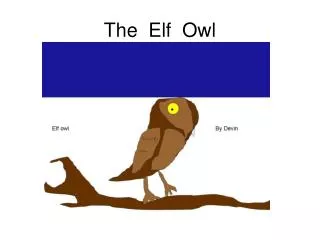
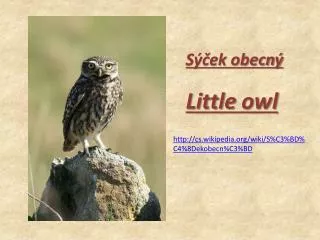
The Little Owl, scientifically known as Athena Noctua, measures about 22 cm in size and inhabits mixed farmland featuring trees, farmsteads, and coastal cliffs where it breeds. Nesting occurs in hollow trees, farm buildings, and rocky cavities, with females laying 3-5 eggs. This nocturnal hunter primarily feeds on beetles, worms, rodents, and small birds. Its flight is undulating and less aerial compared to larger owls, resembling that of a woodpecker. Distinguishable by its pleasing high-pitched "kiew," the Little Owl is primarily found in England.

E N D
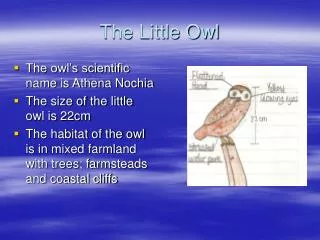
The Little Owl • The owl’s scientific name is Athena Nochia • The size of the little owl is 22cm • The habitat of the owl is in mixed farmland with trees; farmsteads and coastal cliffs
Where the owl breeds • The owl breeds in hollow trees, farm buildings and cavities in rocks. • It lays 3-5 eggs.
What the owl eats • It catches beetles , worms, rodents and some small birds. • This is where the little owl lives it is in England.
How the owl moves • The movement is less aerial than larger owls. • The flight is undulating and like a woodpecker. • The owl only comes out at night. • This is the owl’s undulating flight.
The voice of the little owl • The sound it makes is a pleasing, high pitched kiew.