Harmonious Journey: A Study of “Take the ‘A’ Train” by Duke Ellington
Explore the historical, biographical, and musical significance of Duke Ellington's iconic song "Take the 'A' Train" composed by Billy Strayhorn in 1941. Discover the cultural nuances, rhythm, melody, and impact of this jazz classic.

Harmonious Journey: A Study of “Take the ‘A’ Train” by Duke Ellington
E N D
Presentation Transcript
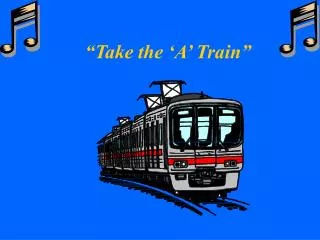
“Take the ‘A’ Train” • Composed by Billy Strayhorn for the Duke Ellington Band • 1941 • Presented by: • Joyce Miles and Kim Olsen • August 12, 1999
Aesthetic Analysis • Form • Binary (2 part form) • Repeated Notes in AABA pattern
Rhythm • Tempo is vivace • Con moto • Meter is 4 beats per measure • “Walking Bass” creates steady beat
Mezzoforte Constant sound - no empty spaces Dimenuendo at end of piece Dynamics
Melody • Homophony - One main melody • “Happy” • Consonance - only one instance of dissonance
Historical Context • Harlem Renaissance • Between WWI & WWII • Northern Movement of African Americans • Destination Harlem • Arts Flourished • Cotton Club
Factors for Success • Fertile spirit of times • “Jazz Age” • CBS • New Sounds...
Biographical Context • Duke Ellington began as a visual artist • Created pictures • “See” with Sound
Our Critical Interpretation:Meaning • “Walking Bass” and snare drum brushes • Synergy of trumpet, saxophone and trombones • Sounds move forward together • Saxophones carry melody in “A”& “B” • Muted trumpets complement • Little dissonance • Brass instruments - train’s horns • Dimenuendo at end - rolling away
Choices and Meanings Affected by Historical and Biographical Context • Song Gives Directions • “Walking Bass” and Steady Rhythm • Swinging Down the Tracks • Happy Melody • Anticipating the spectacle of Harlem • Mutes created smooth ride
Critical Interpretation by Others of “The ‘A’ Train” • Liked making musical pictures of things • Trumpet solo made jazz history • Trumpet trades places with Trombone • Heavily imitated; never replicated
Educational Interpretation • Lesson Plan • Listening Guide • History and Social Studies 6.4- The student will describe the ideas and events of the 1920’s and 1930’s, with emphasis on music, dance, entertainment, and the Harlem Renaissance.