Heuristic Minimization of Two-Level Logic with Blocking Matrix Techniques
110 likes | 234 Views
This document presents a heuristic approach for minimizing two-level logic functions using a structured process that includes expansion, reduction, and irredundant cover techniques. It describes the use of blocking matrices to facilitate cube expansion while preventing intersection with previously established covers. The objective is to create the largest possible implicant by strategically selecting minimal column coverings, ensuring maximum coverage of logic cubes while maintaining efficiency. Detailed procedures for cube expansion and selection of covering sets are articulated to optimize logic function representations.


Heuristic Minimization of Two-Level Logic with Blocking Matrix Techniques
E N D
Presentation Transcript
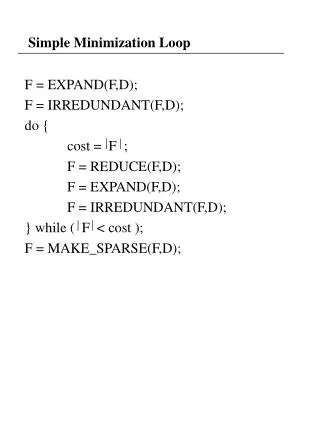
Simple Minimization Loop F = EXPAND(F,D); F = IRREDUNDANT(F,D); do { cost = F ; F = REDUCE(F,D); F = EXPAND(F,D); F = IRREDUNDANT(F,D); } while ( F < cost ); F = MAKE_SPARSE(F,D);
Heuristic Minimization of Two-level Logic z y x (c) (b) (a) (a) Initial cover (b) After Reduction (c) After Expansion in the right direction and Irredundant cover
Expand • Expand • Carry out one cube at a time. • Expand cubes to prime and delete those cubes of F contained in the prime. • Order dependent • goal: • Expand as large as possible • Cover as many cubes as possible
Expand • The Blocking Matrix B(R,C) • block the expansion of a cube C not to intersect off-set • the cube to be expanded • the cover of off-set • Bij = 1 if ( (Cj= 1) and M(R)ij = 0) or • ( (Cj = 0) and M(R)ij = 1) • Ex: • C 0 0 2 • offset M(R) 2 1 2 • 2 1 1 • B(R,C) 0 1 0 • 0 1 0
Blocking Matrix C 0 0 2 offset M(R) 2 1 2 2 1 1 B(R,C) 0 1 0 0 1 0 • What does a “1” mean in the blocking matrix? • The goal of expansion is to raise all the • variables of a cube to 2. But expansion of • the cube can’t cover the vertex in off-set • So, some variable can’t be raised. A “1” • in (i,j) means if variable j is not raised • (lowing) , the expanded cube will not • intersect the cube i of off-set.
Maximum Expansion • L is a column covering of B <=> Every row of B contains a 1 in some column which appears in L. • C+(L,C)j = Cj , j L 2 , otherwise • Proposition : If L is a minimum column • covering of B, then C+(L,C) is a largest • implicant of the function F.
Expand • Covering Matrix : determined by the cube and the given cover Cij = 1 if ((Cj = 1)and M(F)ij 1) or ((Cj = 0)and M(F)ij 0) 0 otherwise Ex: C 0 0 2 M(F) 1 0 1 0 2 0 1 0 0 C(F,C) 1 0 0 0 1 0 1 0 0
Covering Matrix c 0 0 2 M(F) 1 0 1 0 2 0 1 0 0 C(F,c) 1 0 0 0 1 0 1 0 0 • What does a “1” mean in the covering matrix? • => A “1” in (i,j) means if column j is in the • minimal column covering, the cube i is not • covered by the expanded cube. • Select a minimal column covering so that many • rows do not have a 1 in the column cover.
How to Find a Column Covering ? Define two sets : The lowing set : the variables remain the same. The raising set : the variables raised to 2 (expanded ) lowing set step1: Essential column(B) Ex: 1 2 3 4 C = 0 1 0 1 lowing set = {2} B(R,C) = 1 0 1 0 1 0 0 1 0 1 0 1 0 1 0 0 C(F,C) = 1 1 1 1 1 0 0 1 0 0 1 0 0 1 0 1 0 1 1 1 C1 C2 C3 C4 C5
How to Find a Column Covering ? C(F,C) = 1 0 1 0 1 0 C2 1 3 4 B(R,C) = 1 1 0 1 0 1 C3 • Step 2 : Maximal feasible covering column set : • Raising columns to cover as many cubes • as possible • To cover {C3}, {3} must be raised. If • after{3} being raised, the resultant • matrix still has one 1’s in each row, {3} • is a feasible covering column set. • Maximal feasible covering column set is • a feasible covering column set which • covers a maximal number of cubes • Select the MFC which commits the • least number of columns Ex : raising set = {3} {4} lowing set = {2} {1} C+ = { 0 1 2 2}
How to Find a Column Covering? step 3 : If no feasible covering column set (no cube can be covered), choose the column which has the most number of “1”s in C to raise.( Try to partially cover as many cubes as possible)