Understanding Circular Motion: Forces, Tension, and Angular Velocity in Hammer Throwing
This guide explores the dynamics of circular motion using the example of a hammer being spun in a horizontal circle. It highlights key concepts such as constant speed, acceleration due to direction change, and Newton's laws. We derive relevant formulas for resultant forces, tension in the string, and angular velocity. The relationship between these factors is illustrated through an example involving a ball describing a horizontal circle, providing a clear understanding of force components acting within the system. Ideal for students studying physics.

Understanding Circular Motion: Forces, Tension, and Angular Velocity in Hammer Throwing
E N D
Presentation Transcript
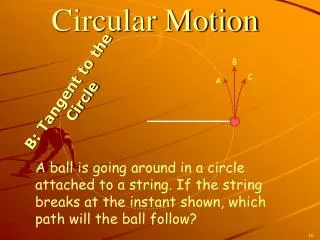
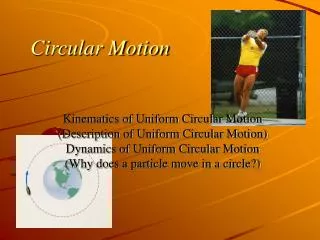
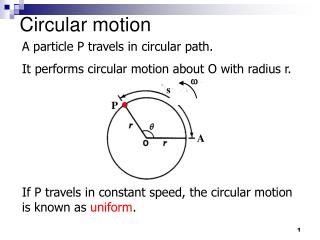
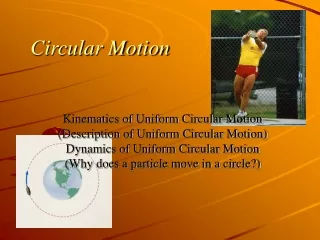
Imagine a hammer (athletics variety) being spun in a horizontal circle At a constant speed
Birds-Eye View ω v r
Side View ω T mg
We know that the hammer is accelerating….. Because the hammer is constantly changing direction (although the speed is constant)
So from Newton’s First and Second Laws, there must be a resultant force Equal to mass x acceleration
For circular motion….. Acceleration = v2 r or rω2 (using v = rω )
So the resultant force ….. = mv2 r or mrω2 (using v = rω )
Which direction do the resultant force and acceleration act in? Towards the centre of the described circle
We can find the resultant force by resolving in the plane of the circle. The only force acting in the horizontal plane is the tension So by resolving T = mrω2
Very important point! The ‘circular force’ is not an additional force – it is the resultant of the forces present.
Typical exam style question Ball hangs from a light piece of inextensible string and describes a horizontal circle of radius,r and makes an angle θ with the vertical . If the mass of the ball is m kg • calculate the tension, T in the string • calculate the angular velocity, ω in terms of g, r and θ.
Diagram θ T mg r
To find the tension…. Resolve vertically Ball is not moving up or down so vertical components must be equal Tcosθ = mg so T = mg cosθ
To find the angular velocity, ω… Resolve horizontally Circular motion so we know that there is a resultant force towards the centre Tsinθ = mrω2 ω =Tsinθ mr
But…… T = mg cosθ so ω = Tsinθ mr Becomes ω = gtanθ r