Circular Motion
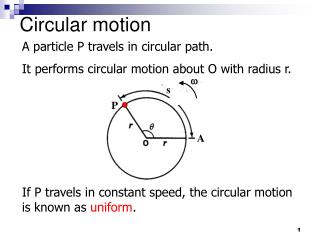
Circular Motion. Circular (Angular) Motion. Measured in degrees, and also in science, radians rather than meters as in linear motion. Otherwise, circular motion is similar to linear (translational) motion. Radian : an angle whose arc length is equal to the radius


Circular Motion
E N D
Presentation Transcript
Circular (Angular) Motion • Measured in degrees, and also in science, radians rather than meters as in linear motion. Otherwise, circular motion is similar to linear (translational) motion. • Radian: an angle whose arc length is equal to the radius • Since there are 2 π rad in one revolution (360˚), conversions from degrees to radians follow: • Rad = degrees x (π/180) AND • Degrees = rad x (180/ π) • 1 rad = 57.3° • 1 revolution = 2π rad
Angular Displacement • Defined as: the angle (in rads) through which a body is rotated in a specific direction and about a specific axis. • Variable: ø • Unit: rads • Angular displacement = change in arc length distance from axis (radius) ∆ø = ∆s r Derivations: R = ∆s and ∆s = ∆ø(r) ∆ø
Example: • If the arc length of a wheel is .50 meters, and the radius is 0.23 meters, what is the angular displacement of an ant riding along ? ∆ø = ∆s r ∆ø = .50 0.23 ∆ø = 2.17 rads
Angular Velocity • Defined as: A measure of the rate of change in angular position • Variable: • Unit: radians per second • = ∆ø ∆T This is the same as : v = 2πr= linear or tangential speed ∆T and if Given mass & Centripetal Force; V= √Fcr/m
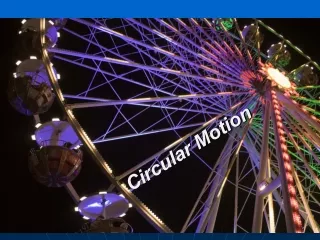
Example • What is the angular velocity of a car on a ferris wheel if the car moves a displacement of 15 rads in 22.5 seconds? • = ∆ø ∆T = 15 22.5 = 0.67 rads/sec
Angular Acceleration • Occurs when there is a change in angular velocity • Variable: • = ∆÷ ∆ t • Unit: rad/s2
Example • a car on the ferris wheel starts at rest and has a velocity of 10 rads/s at top speed, what is the angular acceleration after 60 seconds? • = ∆÷ ∆ t • = 10 – 0 60 = 0.16 rads/s2
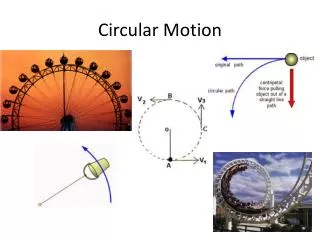
Centripetal Motion • Remember: Newton's second law of motion said the direction of the net force is in the same direction as the acceleration… SO… for an object moving in a circle, there must be an inward force (perpendicular to the direction of velocity) acting upon it in order to cause its inward acceleration
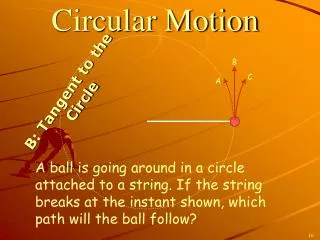
Centripetal Motion • “Center Seeking” • some physical force pushing or pulling an object towards the center of the circle • This force can accelerate the object - by changing its direction - but it cannot change its speed. to change the speed , there would have to be a force in the direction of the motion of the object.
Centripetal Force & Acceleration • Fc = mv2 r Ac = v2 r
Example: • A race car is travelling around a circular track and is 20 meters from the center of the track. If his velocity is 8.5 m/s, what is his centripetal acceleration? Ac = v2 r Ac = 8.52 20 Ac = 3.6 m/s2
Centripetal ForceEX: As the moon orbits the Earth, the force of gravity acting upon the moon provides the centripetal force required for circular motion.
Centripetal Force • EX: As a car makes a turn, the force of friction acting upon the turned wheels of the car provides centripetal force required for circular motion.
Centripetal Force & Acceleration • Period: time it takes for one full revolution of an object. Measured in seconds (s) • Frequency: number of revolutions per unit of time. Measured in Hertz (Hz) • T = 1/F AND F = 1/T
Centrifugal Force • Newton’s third law tells us there is an equal & opposite force paired with every force… • For Centripetal Force, this is an equal force which pulls outward during circular motion, called centrifugal Force… • However, this is merely the inertia of an object resisting the changes of direction, as it tends to continue in a straight line motion