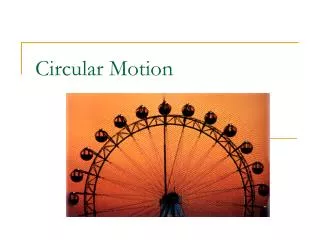
Circular Motion
This article delves into the derivation of the formula for centripetal acceleration, a fundamental concept in circular motion. It explains the relationship between the radius of the circular path (r) and the tangential velocity (v) of an object moving in a circle. By analyzing right triangles formed by velocity vectors, it demonstrates how the change in velocity (Δv) relates to radius and time, leading to the formula ( a = frac{v^2}{r} ). Readers will gain a clear understanding of how centripetal acceleration acts on objects in uniform circular motion.

Circular Motion
E N D
Presentation Transcript
Circular Motion Deriving the formula for centripetal acceleration
Deriving Formula for Centripetal Acceleration v r is the radius of the circle that the object is traveling v is the tangential velocity r and v form a right triangle r
Deriving Formula for Centripetal Acceleration v1 Θ v2 r r Angle between r of 1st triangle and 2nd triangle = θ Angle between hypoteneuse of 1st triangle and hypotenuse of 2nd triangle = θ Thus, angle between v of 1st triangle and 2nd triangle = θ Θ
Deriving Formula for Centripetal Acceleration v1 l One triangle is formed using the two points where we determined the velocity The angle across from l is θ v2 r r
Deriving Formula for Centripetal Acceleration v1 v1 Δv v2 l v2 r r Another triangle is formed with the velocity vectors Note – the vectors are being subtracted because they are tail to tail Δv = v2 – v1 The angle across from Δv is θ
Deriving Formula for Centripetal Acceleration v1 v1 Δv v2 l v2 r r If the object is being swung with a constant speed then the magnitude of v1 and the magnitude of v2 are equal. Thus – the two triangles are similar v1 = Δv rl
Deriving Formula for Centripetal Acceleration v1 = Δv r l Δv = v1l r Divide both sides by Δt Δv = v1l ΔtΔt r
Deriving Formula for Centripetal Acceleration Δv = v1l ΔtΔt r Δv = a Δt v = l Δt So . . . . . .