Download
1 / 105
1.05k likes | 1.2k Views
Dive into the intricate world of the nervous system, exploring its two main divisions: the Central Nervous System (CNS) comprising the brain and spinal cord, and the Peripheral Nervous System (PNS). Learn about the roles of afferent and efferent nerves in sensory perception and motor control. Examine the protection of the brain and spinal cord through meninges and cerebrospinal fluid, and discover the main structures of the brain, such as the medulla oblongata, pons, and cerebellum, each vital for essential functions. Understand conditions like hydrocephalus and the significance of spinal block vs. epidural procedures.

E N D
Nervous system “Let’s get wired!”
Divisions • Central Nervous System – CNS • Brain and spinal cord • Peripheral Nervous System • Outer region – cranial/spinal origination
A vs E • Afferent nerves – incoming senses • Efferent nerves – outgoing motor
Innervation • Somatic - skeletal • Autonomic – visceral – smooth/cardiac/glands • Sympathetic – fight or flight response – immediate threat • Parasympathetic – resting/regroup activities
Anatomy of the brain and spinal cord • Skull • Meninges • Dura - epidural/subdural space • Arachnoid – subarachnoid space • Pia
Cerebrospinal fluid • Protection of the brain and spinal cord • Circulates chemicals for internal brain function – ie. CO-2 changes will cause medulla oblongata to accommodate respiratory function to meet body needs for homeostasis • Mainly found in subarachnoid space and ventricles (4) two in cerebrum, one medial/below these, and one in cerebellum (brainstem) • Formed in choroid plexus – extracted from blood
Circulation of CSF • Formed in choroid plexus • Ventricles • Central canal/subarachnoid space • Absorbed back into the blood • Normal adult CSF fluid is 140 ml
Lumbar puncture • CSF from subarachnoid space in L3-4 • Pt. in R/L lateral fetal position or sitting on bedside • Pt. remains flat X 12 hrs. after procedure • Blood patch sometimes required • Tests for infection, disease
Hydrocephalus • Congenital / tumor • Ventricles malfunction and disallow normal CSF flow • 1-3:1000 births
1.Describe the difference between a spinal block and an epidural. 2. What is “hydrocephalus” and how can it be treated?
Structure of the spinal cord • Protected by vertebral column • Extends from foramen magnum to the distal end of the first lumbar (45 cm – 18 in.) • Spinal cavity includes: cord, blood vessels, adipose tissue, meninges, and CS fluid • Split into two symmetrical halves – anterior surface is deeper and wider than the posterior surface • Nerve roots project from each side of cord
Cont. • Dorsal nerve root – sensory information to cord • Ventral nerve root – motor information out of the cord • Each side of the cord the dorsal and ventral nerve roots join together to form a spinal nerve (peripheral)
Spinal cord functions • Conducts information to and from the brain • Integrator – reflex center – for all spinal reflexes • Refer to ascending/descending tracts pgs. 382-383
Brain • One of the largest vital adult organs • Weighs 3 lbs. • 100 billion neurons/900 glia (support cells) – also called neuoglia • Mitotic division only occurs in-utero and first few months post-natal • Cells will mature, but not increase in number • Maturity by 18 y.o.
Brain – six divisions • Medulla oblongata • Pons • Midbrain • Cerebellum • Diencephalon • Cerebrum
Brainstem Composed of: Medulla oblongata Pons Midbrain
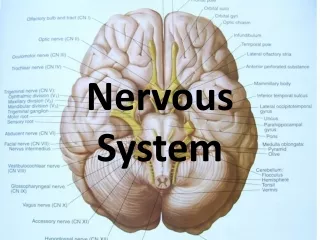
Underside of the brain, showing the brainstem and cranial nerves
Medulla oblongata • Attaches to spinal cord • An extension of the spinal cord above the foramen magnum • One inch in size • Separated from the pons by horizontal groove • Controls cardiac, respiratory and vasomotor function • Non-vital reflexes – vomiting, cough, sneeze swallow
Pons • Above the medulla oblongata • Motor control • Sensory analysis • Reflex mediator for the 5th-8th cranial nerves • Helps with respiratory regulation
Midbrain • Mesencephalon • Above the pons and below the cerebrum • Vision, hearing, eye movement, body movement
Functions of the cerebellum • Second largest part of the brain • Located below the posterior section of the cerebrum • Responsible for movement coordination – smooth, precise and steady as to force, rate and extent • Posture • Balance – equilibrium receptors from ear
Disease of the cerebellum • Abscess, hemorrhage, tumor, trauma • Ataxia – muscle incoordination • Hypotonia • Tremors • Gait disturbance • Balance disturbance – staggering, lurching, raising foot to high to step, bringing foot down very hard
Diencephalon • Between the cerebrum and midbrain • Includes thalmus,hypothalmus, optic chiasma, and pineal body • Also known as the “emotional brain” or limbic system
Thalamus • Processes auditory and visual signals • Relay station for sensory perception to cerebrum • Conscious recognition of pain, temperature and touch • Partly responsible for emotions by associating sensory impulses with feelings of pleasant vs unpleasant • Part in arousal/alerting mechanism • Part in complex reflex movement
Hypothalmus • Autonomic center – visceral • Sense of smell • Link between mind and body • Pleasure/reward center – eating, drinking, sex • Relay station between cerebral cortex and autonomic centers • Mind over matter philosophy – psychosomatic disease – positive/negative • Regulates pituitary – renal function • Hormone regulation • Maintains wake state • Appetite regulation • Regulation of body temperature
Pineal body • Above the midbrain • Looks line pine cone • Function not well understood • Regulates biological clock • Produces melatonin – synchronize various body functions with each other and external stimuli – such as onset of puberty and menses – also helps with light perception – called the “third eye”
Complete handout Due next class!