Understanding Statistical Inference: Sampling and Estimation Procedures in Parametric Models
This text delves into the core concepts of statistical inference, particularly focusing on sampling and estimation within parametric models. It covers the definition of statistical models, how to derive model parameters from samples, and the notion of prediction and regression. Key techniques such as point estimation, hypothesis testing, confidence intervals, and maximum likelihood estimation are explored. A comparison of parametric and nonparametric methods is also presented, highlighting the importance of sampling distributions and the properties of estimators for informed decision-making based on data analysis.

Understanding Statistical Inference: Sampling and Estimation Procedures in Parametric Models
E N D
Presentation Transcript
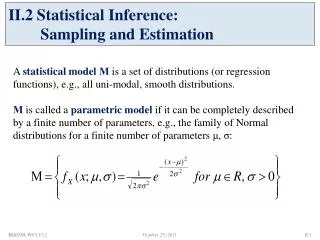
II.2 Statistical Inference: • Sampling and Estimation A statistical model Μis a set of distributions (or regression functions), e.g., all uni-modal, smooth distributions. Μis called a parametric model if it can be completely described by a finite number of parameters, e.g., the family of Normal distributions for a finite number of parameters μ, σ: IR&DM, WS'11/12
Statistical Inference Given a parametric model M and a sample X1,...,Xn, how do we infer (learn) the parameters of M? For multivariate models with observed variable X and „outcome (response)“ variable Y, this is called prediction or regression,for a discrete outcome variable this is also called classification. r(x) = E[Y | X=x] is called the regression function. IR&DM, WS'11/12
Idea of Sampling Distribution X (e.g., a population, objects of interest) Statistical Inference What can we say about X based on X1,…,Xn? Samples X1,…,Xn drawn from X (e.g., people, objects) Distrib. Param. Sample Param. μXmean variance N size n Example: Suppose we want to estimate the average salary of employees in German companies. Sample 1: Suppose we look at n=200 top-paid CEOs of major banks. Sample 2: Suppose we look at n=100 employees across all kinds of companies. IR&DM, WS'11/12
Basic Types of Statistical Inference • Given a set of iid. samples X1,...,Xn~ X • of an unknown distribution X. • e.g.: n single-coin-toss experiments X1,...,Xn ~ X: Bernoulli(p) • Parameter Estimation • e.g.: - what is the parameter p of X: Bernoulli(p) ? • - what is E[X], the cdf FX of X, the pdffX of X, etc.? • Confidence Intervals • e.g.: give me all values C=(a,b) such that P(pC) ≥ 0.95 • where a and b are derived from samples X1,...,Xn • Hypothesis Testing • e.g.: H0 : p = 1/2 vs. H1 : p ≠ 1/2 IR&DM, WS'11/12
Statistical Estimators A point estimatorfor a parameter of a prob. distribution X is a random variable derived from an iid. sample X1,...,Xn. Examples: Sample mean: Sample variance: An estimator for parameter is unbiased if E[ ] = ; otherwise the estimator has bias E[ ] – . An estimator on a sample of size n is consistent if Sample mean and sample variance are unbiased and consistent estimators of μX and . IR&DM, WS'11/12
Estimator Error Let be an estimator for parameter over iid. samples X1, ...,Xn. The distribution of is called the sampling distribution. The standard error for is: The mean squared error (MSE) for is: Theorem: If bias 0 and se 0 then the estimator is consistent. The estimator is asymptotically Normal if converges in distribution to standard Normal N(0,1). IR&DM, WS'11/12
Types of Estimation • Nonparametric Estimation • No assumptions about model M nor the parameters θ of the underlying distribution X • “Plug-in estimators” (e.g. histograms) to approximate X • Parametric Estimation (Inference) • Requires assumptions about model M and the parameters θof the underlying distribution X • Analytical or numerical methods for estimating θ • Method-of-Moments estimator • Maximum Likelihood estimator • and Expectation Maximization (EM) IR&DM, WS'11/12
Nonparametric Estimation The empirical distribution function is the cdf that puts probability mass 1/n at each data point Xi: A statistical functional (“statistics”) T(F) is any function over F, e.g., mean, variance, skewness, median, quantiles, correlation. The plug-in estimator of = T(F) is: Simply use instead of F to calculate the statistics T of interest. IR&DM, WS'11/12
Histograms as Density Estimators Instead of the full empirical distribution, often compact data synopses may be used, such as histograms where X1, ...,Xnare grouped into m cells (buckets) c1, ..., cm with bucket boundaries lb(ci) and ub(ci) s.t. lb(c1) = , ub(cm ) = , ub(ci) = lb(ci+1 ) for 1 i<m, and freqf(ci) = freqF(ci) = Example: X1= 1 X2= 1 X3= 2 X4= 2 X5= 2 X6= 3 … X20=7 fX(x) 5/20 4/20 3/20 3/20 2/20 2/20 1/20 x 1 2 3 4 5 6 7 Histograms provide a (discontinuous) density estimator. IR&DM, WS'11/12
Parametric Inference (1):Method of Moments Suppose parameter θ = (θ1,…,θk ) has k components. Compute j-th moment: j-th sample moment: for 1 ≤ j ≤ k Estimate parameter by method-of-moments estimators.t. and … … and (for the first k moments) Solve equation system with k equations and k unknowns. Method-of-moments estimators are usually consistent and asymptotically Normal, but may be biased. IR&DM, WS'11/12
Parametric Inference (2):Maximum Likelihood Estimators (MLE) Let X1,...,Xn be iid. with pdf f(x;θ). Estimate parameter of a postulated distribution f(x;) such that the likelihood that the sample values x1,...,xnare generated by this distribution is maximized. Maximum likelihood estimation: Maximize L(x1,...,xn; ) ≈ P[x1, ...,xn originate from f(x; )] Usually formulated as Ln() = ∏i f(Xi; ) Or (alternatively) Maximize ln() = log Ln() The value that maximizes Ln() is the MLE of . If analytically untractable use numerical iteration methods IR&DM, WS'11/12
Simple Example forMaximum Likelihood Estimator • Given: • Coin toss experiment (Bernoulli distribution) with • unknown parameter p for seeing heads, 1-p for tails • Sample (data): h times head with n coin tosses • Want: Maximum likelihood estimation of p Let L(h, n, p) with h = ∑iXi Maximize log-likelihood function: log L (h, n, p) IR&DM, WS'11/12
MLE for Parameters of Normal Distributions IR&DM, WS'11/12
MLE Properties Maximum Likelihood estimators are consistent, asymptotically Normal, and asymptotically optimal (i.e., efficient) in the following sense: Consider two estimators U and T which are asymptotically Normal. Let u2 and t2 denote the variances of the two Normal distributions to which U and T converge in probability. The asymptotic relative efficiency of U to T is ARE(U,T) := t2/u2 . Theorem: For an MLE and any other estimator the following inequality holds: That is, among all estimators MLE has the smallest variance. IR&DM, WS'11/12
Bayesian Viewpoint of Parameter Estimation • Assume prior distribution g()of parameter • Choose statistical model (generative model) f (x | ) • that reflects our beliefs about RV X • Given RVs X1,...,Xn for the observed data, • the posterior distribution is h ( | x1,...,xn) For X1= x1, ... ,Xn= xn the likelihood is which implies (posterior is proportional to likelihood times prior) MAP estimator (maximum a posteriori): Compute that maximizesh( | x1, …, xn)given a prior for . IR&DM, WS'11/12
Analytically Non-tractable MLE for parametersof Multivariate Normal Mixture Consider samples from a k-mixture of m-dimensional Normal distributions with the density (e.g. height and weight of males and females): with expectation values and invertible, positive definite, symmetric mm covariance matrices Maximize log-likelihood function: IR&DM, WS'11/12
Expectation-Maximization Method (EM) • Key idea: • When L(X1,...,Xn, θ) (where the Xi and are possibly multivariate) • is analytically intractable then • introduce latent (i.e., hidden, invisible, missing) random variable(s) Z • such that • the joint distribution J(X1,...,Xn, Z, ) of the “complete” data • is tractable (often with Z actually being multivariate: Z1,...,Zm) • iteratively derive the expected complete-data likelihoodby integrating J • and find best : EZ|X,[J(X1,…,Xn, Z, )] IR&DM, WS'11/12
EM Procedure Initialization: choose start estimate for (0) (e.g., using Method-of-Moments estimator) Iterate(t=0, 1, …) until convergence: E step (expectation): estimate posterior probability of Z: P[Z | X1,…,Xn, (t)] assuming were known and equal to previous estimate (t), and compute EZ|X,θ(t)[log J(X1,…,Xn, Z, (t))] by integrating over values for Z M step (maximization, MLE step): Estimate (t+1) by maximizing (t+1) = arg maxθ EZ|X,θ[log J(X1,…,Xn, Z, )] Convergence is guaranteed (because the E step computes a lower bound of the true L function, and the M step yields monotonically non-decreasing likelihood), but may result in local maximum of (log-)likelihood function IR&DM, WS'11/12
EM Example for Multivariate Normal Mixture Expectation step (E step): Zij = 1 if ith data point Xi was generated by jth component, 0 otherwise Maximization step (M step): See L. Wasserman, p.121 ff. for k=2, m=1 IR&DM, WS'11/12
Confidence Intervals Estimator T for an interval for parameter such that [T-a, T+a] is theconfidence interval and 1– is theconfidence level. For the distribution of random variable X, a value x (0< <1) with is called a-quantile; the 0.5-quantile is called the median. For the Normal distribution N(0,1) the -quantile is denoted . • For a given aorα, find a value z of N(0,1) • that denotes the [T-a, T+a] conf. interval • or a corresponding -quantilefor 1– . IR&DM, WS'11/12
For confidence intervalorconfidence level 1-set then then look up (z) to find 1–α Confidence Intervals for Expectations (1) Let x1, ..., xn be a sample from a distribution with unknown expectation and known variance 2. For sufficiently large n, the sample mean is N(,2/n) distributed and is N(0,1) distributed: IR&DM, WS'11/12
Confidence Intervals for Expectations (2) Let X1, ..., Xn be an iid. sample from a distribution X with unknown expectation and unknown variance2 and known sample variance S2. For sufficiently large n, the random variable has a t distribution (Student distribution) with n-1 degrees of freedom: with the Gamma function: IR&DM, WS'11/12
Summary of Section II.2 • Quality measures for statistical estimators • Nonparametric vs. parametric estimation • Histograms as generic (nonparametric) plug-in estimators • Method-of-Moments estimator good initial guess but may be biased • Maximum-Likelihoodestimator & Expectation Maximization • Confidence intervals for parameters IR&DM, WS'11/12
Normal Distribution Table IR&DM, WS'11/12
Student‘s t Distribution Table IR&DM, WS'11/12