Understanding Institutional Audit: QAA's Role in Higher Education Quality Assurance
210 likes | 325 Views
This document outlines the purpose and processes of the Quality Assurance Agency (QAA) in conducting Institutional Audits. It emphasizes the evidence-based peer review process that ensures high standards and continuous improvement in higher education (HE) institutions. Key components include the Institutional Briefing Paper (IBP), the Student Written Submission (SWS), and the timeline for audits. By engaging with institutions and students, the QAA aims to uphold the integrity of HE qualifications while promoting self-evaluation and enhancement of learning environments.


Understanding Institutional Audit: QAA's Role in Higher Education Quality Assurance
E N D
Presentation Transcript
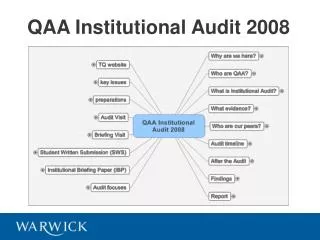
Why are we here? • provide and gather information • ask and answer questions; discuss issues • reassurance - we're confident • reassurance - this shouldn't affect you very much • nice cup of tea and a biscuit
Who are QAA? • Quality Assurance Agency (QAA)'s mission: to safeguard the public interest in sound standards of HE qualifications and to inform and encourage continuous improvement in the management of the quality of HE
What is Institutional Audit? • an evidence-based process carried out through peer review ... with an emphasis on students and their learning • publicly credible, independent and rigorous scrutiny of institutions • encourages institutions to be self-evaluative
Audit focuses • everything! – at the institutional management level • PGR • collaborative courses • published information; Europe • enhancement: deliberate steps at institutional level to improve the quality of learning opportunities
What is Institutional Audit? • an evidence-based process carried out through peer review ... with an emphasis on students and their learning • publicly credible, independent and rigorous scrutiny of institutions • encourages institutions to be self-evaluative
What evidence? • Institutional Briefing Paper (IBP) • Student Written Submission (SWS) • strategies, policies, reviews, minutes... • meetings with staff and students
Institutional Briefing Paper (IBP) • key document • 30 pages • description, self-aware reflection and analysis
Student Written Submission (SWS) • prepared by Students' Union • piece of evidence for audit team • TQ and SU talking frequently
What is Institutional Audit? • an evidence-based process carried out through peer review ... with an emphasis on students and their learning • publicly credible, independent and rigorous scrutiny of institutions • encourages institutions to be self-evaluative
Who are our peers? • 4 people, plus Audit secretary • Julia Clarke, Leeds • Richard Gadsden, Loughborough • Richard Tong, UWIC • Denis Wright, Imperial • Louise Walmsley, Manchester (Audit secretary) Clarke Gadsden Tong
Audit timeline • 1 Sept: IBP and SWS to QAA • 7-9 October: Briefing Visit • 10 Oct-9 Nov: busy, busy, busy • 10-14 Nov: Audit visit
After the Audit • by end Nov: key findings letter • 16 January: draft report • 13 March: final report • 10 April: report published
Findings • Judgement on standards • "present and likely future management" • confidence • limited confidence • no confidence • Judgement on quality • "present and likely future management" • confidence • limited confidence • no confidence
Report • 2-page summary • main report • technical annex
Briefing Visit • 7-9 October • Audit team learns more about university • meets the VC • meets key TQ people (academic & admin) • meets student reps
Audit Visit • audit trails • likely to be based on recent SDRs • 10-14 November • Audit team tests evidence, makes judgements • 4/5 meetings, 8 people in each, 1 with students • "high-value" people - range of roles
Preparations • Departmental healthcheck • drafting IBP now • QAA Code of Practice check
Key issues • course specs • enhancement • assessment conventions • information flows
TQ website • www2.warwick.ac.uk/services/quality • warwick.ac.uk/go/quality • .../categories/institutionalaudit/
Questions? • Karen O’Brien: 23342, k.e.o-brien@warwick.ac.uk • Julian Moss: 22707, julian.moss@warwick.ac.uk • Jenny Bradfield: 74464, j.bradfield@warwick.ac.uk • Helen Hutchings, 50239, h.hutchings@warwick.ac.uk