Download
1 / 29
290 likes | 415 Views
This study delves into wavefunction determination through the relationship of angular frequency ω(k) and wave vectors k. Using the dispersion equation, we derive ω(k) and calculate wave packet velocities, capturing significant dynamics at various time intervals. Measurements reveal spatial displacements at key instances, emphasizing changes in group velocities due to different k-values and ensuing dispersion effects. The analysis also explores the robustness of Gaussian wave packets, highlighting their ability to maintain integrity despite variations in wave velocities.

E N D
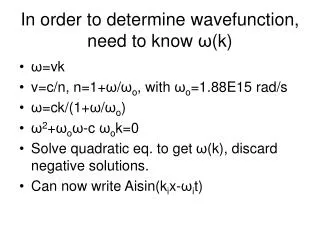
In order to determine wavefunction, need to know ω(k) • ω=vk • v=c/n, n=1+ω/ωo, with ωo=1.88E15 rad/s • ω=ck/(1+ω/ωo) • ω2+ωoω-c ωok=0 • Solve quadratic eq. to get ω(k), discard negative solutions. • Can now write Aisin(kix-ωit)
For t=0, Ai=1 Graphically measure Δx to be 6um, measuring at position where envelope goes to ½ its max For Δk=ko/5=1,260,000 ΔkΔx=7.56
For t=1ps, Ai=1 Graphically measure Δx to be 11um, measuring at position where envelope goes to ½ its max For Δk=ko/5=1,260,000 ΔkΔx=13.8
c) Determine velocity of wavepacket • Center of wavepacket in b) is about 134µm • Center of wavepacket in a) is 0µm • Δt=1ps=1E-12s • v=Δx/Δt=134E-6m/1E-12s=1.34E8=0.45c
D) Analytical solution for vg • vg=dω/dk assume k=ko
Δk=ko/25, t=0 Graphically measure Δx to be 3.6um, measuring at position where envelope goes to ½ its max For Δk=0.8ko=5,040,000 ΔkΔx=18.144
Measuring ΔkΔx • can’t graphically measure Δx • Why? • Width in k values means that each wave travels with a much different velocity than it neighboring k-value. This mixes up the wavepackets high dispersion • ΔkΔx not really measurable • Therefore can’t measure shift in peak of wavepacket. • Analytical solution for group velocity shouldn’t change, though…
Δk=ko/100, Ai Gaussian t=0 Graphically measure Δx to be 9um, measuring at position where envelope goes to ~½ its max Now, we should assume Δk=2σ=ko/10=630,000 ΔkΔx~6
Δk=ko/100, Ai Gaussian t=1ps Graphically measure Δx to be 12um, measuring at position where envelope goes to ~½ its max Now, we should assume Δk=2σ=ko/10=630,000 ΔkΔx~8
Why does Gaussian hold together better? • Most of the weight lies near ko, so the waves far from ko do not contribute as much, even though they travel with the most different velocity • The group velocity of the wavepacket will be the same as for the other wavepackets, as will the analytical solution