Download
1 / 6
70 likes | 193 Views
Energy. Every change that occurs involves .Moving objects have energyYou can tell an object has energy when it: Changes its environmentChanges itselfEnergyElectrical moving electronsChemical from bondsThermal- heat. Energy. Energy exists in many different formsIt may look different,

E N D
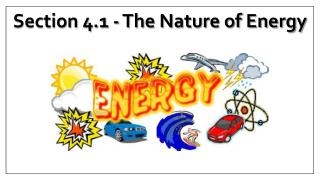
1. The Nature of Energy Section 4.1
2. Energy Every change that occurs involves .
Moving objects have energy
You can tell an object has energy when it:
Changes its environment
Changes itself
Energy
Electrical – moving electrons
Chemical – from bonds
Thermal- heat
3. Energy Energy exists in many different forms
It may look different, but it’s still energy.
Examples: fire, movement, gasoline in a bucket
Kinetic energy- energy in the form of motion
Depends on mass and velocity of an object
Increase in either mass or velocity = increase in energy
KE =1/2 mv2
Units = kg*m/s
4. Types of Energy KE = ½ mv2 Velocity changes will impact KE more because velocity is squared.
Potential Energy – energy of position
Energy in stationary objects and bonds
Elastic Potential Energy – Energy of compression or stretching
Chemical Potential Energy – Energy stored in bonds
Gasoline, food, hand warmers
5. Types of Energy Gravitational Potential Energy- Energy stored due to position above the surface of Earth
Depends on mass of object, height of object above ground, and acceleration due to gravity
GPE = m x h x a
All energy – measured in units of Joules
1 J = 1 kgm2/ s2
Energy can be converted:
As an object falls, GPE decreases and KE increases
6. Our energy use and it’s effects http://www.teachersdomain.org/resources/tdc02/sci/life/eco/energyuse/index.html