
Experimental Error
E N D
Presentation Transcript
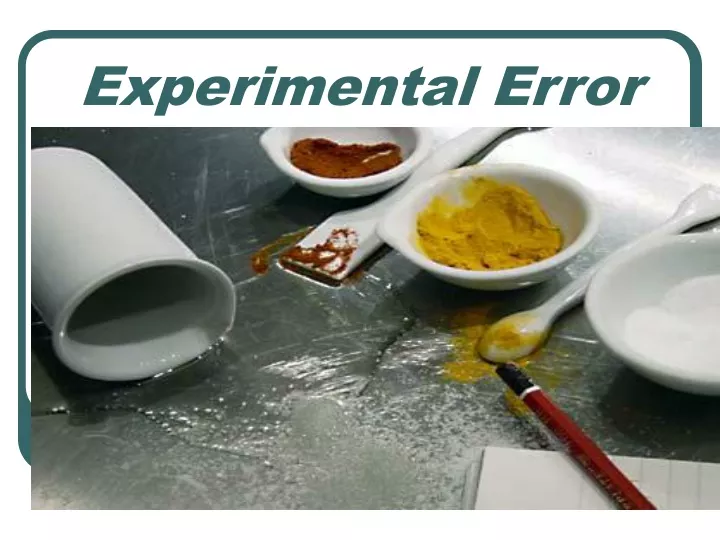
What is Experimental Error? • Aspects of the design of the experiment that cause results to be off. • Every experiment has some sources of experimental error • Anticipating sources or error beforehand can result in a better design of experiment
Things that are NOT Exper. Error:Blunders or Mistakes • These are goofs or accidents that happen during the lab • “We measured wrong” • “We calculated wrong” • “We spilled some of our test sample” • “We forgot to press tare”
Examples of Experimental Error:Uncertainty in Measurements • All measurements have a guessed last digit • Therefore there is inherent error in all measurements and calculations with these measurements • Since this is constant, do not mention as a source of error in reports
Examples of Experimental Error:Human Error • Ex: Using a stopwatch • Ex: Noting the temperature at which an object is completely melted
Examples of Experimental Error:Difficulty in Measurement • Not the same as “We measured wrong” • This is caused by a legitimate reason that makes reading the instrument correctly difficult • Examples: • Measuring height of counter • Measuring diameter of balloon
Examples of Experimental Error:False Assumptions • Not incorrect assumptions, but assumptions that aren’t 100% true • Examples • Using odometer to measure distance from house to school • Using formula for sphere to calculate volume of a balloon • Assuming temp of metal is the same as the temp of the water it is in
Examples of Experimental Error:“Varying Unvariables” • In a valid experiment, only independent variable should change. All other conditions should remain constant throughout experiment. • Sometimes other conditions vary that we did not foresee or that we have no control over • Examples • During an experiment, room temperature may fluctuate • Different amounts of light may reach each plant if near window or shadows • Air pressure in room fluctuates while measuring balloon volume.
Examples of Experimental Error:Contamination of Chemicals • This one is a border-line blunder • May come from unclean glassware • Chemicals get old and change • Other people may have contaminated stock chemicals
Your Turn: The volume of a rock is measured by water displacement. • Some water is placed in a cylinder and recorded. • A rock is placed in the cylinder and that volume is measured. • The 2 measurements are subtracted to obtain the volume of the rock.
Your Turn: The volume of a rock is measured by water displacement.
Your turn: The volume of a penny is determined by the following method. • Use a ruler to measure the diameter of a penny. • Calculate the radius of the penny. • Measure the height of the penny • Use the formula for a cylinder, v=πr2h.
Your turn: The volume of a penny is determined by cylinder formula.
In Gas Laws Lab, Station #9 • Did your results support Charles’ Law? • What were some sources of error?
Pick up your lab notebooks from table # 3 in the back of the room. • Grades posted include everything except extra credit CLC points.