Understanding Truth Tables and Compound Statements
This lesson focuses on constructing truth tables to analyze the truth values of various compound statements. Key concepts include the definition of a truth table, the role of negation, conjunctions, and disjunctions. Students will learn that conjunctions are true only when both statements are true, while disjunctions are true if at least one statement is true. The process of creating truth tables is demonstrated with step-by-step instructions using examples such as (p ∧ ¬q) and (p ∨ q) to solidify understanding.

Understanding Truth Tables and Compound Statements
E N D
Presentation Transcript
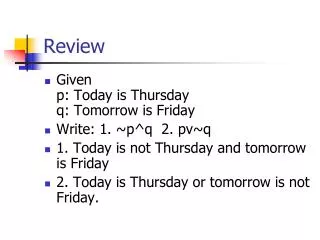
Review • Givenp: Today is Thursdayq: Tomorrow is Friday • Write: 1. ~p^q 2. pv~q • 1. Today is not Thursday and tomorrow is Friday • 2. Today is Thursday or tomorrow is not Friday.
Truth Tables Geometry Unit 9, Day 3 Mr. Zampetti
Objective • To construct truth tables and determine the truth value of compound statements.
Definition • Truth Table – a convenient way to organize the truth values of statements.
Truth Values • Conjunctions are true ONLY when BOTH statements are true. • Look at the example in your notes packet.
Conjunction Truth Table Remember a conjunction is only true when BOTH are true!
Truth Values • Disjunctions are true if AT LEAST ONE statement is true. • Look at the example in your notes packet.
Disjunction Truth Table Remember a disjunction is true when AT LEAST ONE are true!
Constructing Truth Tables • GIVEN: p^~q • Step 1: Make columns with headings p, q, ~q, and p^~q
Constructing Truth Tables • p^~q • Step 1: Make columns with headings p, q, ~q, and p^~q • Step 2: List possibilities of p and q.
Constructing Truth Tables • p^~q • Step 1: Make columns with headings p, q, ~q, and p^~q • Step 2: List possibilities of p and q. • Step 3: Determine ~q by using q.
Constructing Truth Tables • p^~q • Step 1: Make columns with headings p, q, ~q, and p^~q • Step 2: List possibilities of p and q. • Step 3: Determine ~q by using q. • Step 4: Determine p^~q by using p and ~q.
Homework • Work Packet: Truth Tables