Defining Durability: Reference Values for Structural Design - Dr. Paul J. Tikalsky
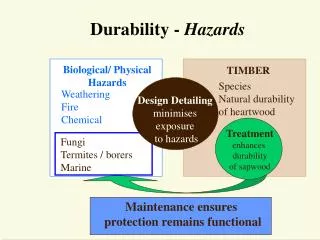
This presentation by Dr. Paul J. Tikalsky at Euro-SiBRAM 2002 outlines the essential elements for defining durability in structural design. It covers detailed knowledge of structural requirements, environmental factors, and material science, as well as the mechanisms of deterioration affecting structural integrity. The session emphasizes creating reference values based on desired service life, exposure conditions, and performance predictive models. Key considerations include chloride diffusion, permeability, and the combined effects of multiple distress mechanisms on structure longevity.

Defining Durability: Reference Values for Structural Design - Dr. Paul J. Tikalsky
E N D
Presentation Transcript
Session 4 Reference Values for Durability Design Dr. Paul J. Tikalsky, P.E., FACIThe Pennsylvania State University USA
Defining Durability • Detailed Knowledge • Structural Requirements • Environment • Material Science • Deterioration Mechanisms Euro-SiBRAM’2002 Prague, June 24 to 26, 2002, Czech Republic
Structural Requirements • Define the precise design function • Compression, Tension, Shear, Combined? • Stiffness? Brace? Load Sharing? • Define the structural design RV • Define the long term and short term behavioral requirements of the structure • Define the desired design life Euro-SiBRAM’2002 Prague, June 24 to 26, 2002, Czech Republic
Define the Environment • Concentrations of chemical and gases • Wet/Dry cycles • Freeze/Thaw cycles • Physical loadings • Abrasion • Fluid contact and velocity • Vibrations/Repeated cycles Euro-SiBRAM’2002 Prague, June 24 to 26, 2002, Czech Republic
Level of Chemical Exposure • Chemical Exposure • Sulfate concentration (0-5% SO4-2) • Chloride concentration (0-3 kg/m3) • Carbon dioxide or monoxide concentration • Acid concentration and type • Other chemical concentrations Euro-SiBRAM’2002 Prague, June 24 to 26, 2002, Czech Republic
Creating Reference Values • Reference Values for Durability depend on multiple variables • Desired years of service • Acceptability or Consequences of deterioration (nuclear power plant or retail space) • Compounding exposure conditions • Time of testing or evaluation Euro-SiBRAM’2002 Prague, June 24 to 26, 2002, Czech Republic
Material Science Models • Appropriate models must exist for the prediction of deterioration • Time based models that progress with predictably changing exposure conditions Euro-SiBRAM’2002 Prague, June 24 to 26, 2002, Czech Republic
Chloride Diffusion Model C(x,t) = chloride concentration t = time x = depth Co = surface chloride concentration Dc = chloride diffusion constant erf = Error Function Euro-SiBRAM’2002 Prague, June 24 to 26, 2002, Czech Republic
Chloride Concentration vs Time Euro-SiBRAM’2002 Prague, June 24 to 26, 2002, Czech Republic
Subsidence Cracking Model • p = probability of settlement cracking • y = 1.37 - 0.023x1 - 0.56x2 + 0.011x3 • x1 = concrete cover, mm • x2 = concrete cover / bar size • x3 = concrete slump, mm Euro-SiBRAM’2002 Prague, June 24 to 26, 2002, Czech Republic
Permeability • K C= permeability coefficient • Q = rate of flow • H/L = ratio of head of fluid to percolation length • A = cross section area under pressure Euro-SiBRAM’2002 Prague, June 24 to 26, 2002, Czech Republic
Chloride Penetration • Test Method: AASHTO T277 (Coulombs passed in 6 hours) Euro-SiBRAM’2002 Prague, June 24 to 26, 2002, Czech Republic
Euro-SiBRAM’2002 Prague, June 24 to 26, 2002, Czech Republic
Ex: Defining Permeability Performance Euro-SiBRAM’2002 Prague, June 24 to 26, 2002, Czech Republic
Ex: Defining Shrinkage Performance Euro-SiBRAM’2002 Prague, June 24 to 26, 2002, Czech Republic
Ex: Defining ASR Performance Euro-SiBRAM’2002 Prague, June 24 to 26, 2002, Czech Republic
Ex: Defining Sulfate Performance Euro-SiBRAM’2002 Prague, June 24 to 26, 2002, Czech Republic
Models and Design Decisions • Do models exist to predict durability based performance? • Are the models based on materials science? • How can tests at the time of construction be verified by field performance? Euro-SiBRAM’2002 Prague, June 24 to 26, 2002, Czech Republic
Combined Effects • Many durability problems are a result of multiple distress mechanisms. • How can a more holistic model be developed and implemented? (e.g. “Life 365”) Euro-SiBRAM’2002 Prague, June 24 to 26, 2002, Czech Republic
Prof. Paul J. Tikalsky, P.E., FACIPenn State University Transportation Infrastructure Lab. 3127 Research DriveState College, PA 16801 USATikalsky@psu.edu Euro-SiBRAM’2002 Prague, June 24 to 26, 2002, Czech Republic