Download
1 / 15
150 likes | 294 Views
This presentation highlights key developments in a nonhydrostatic, soundproof model for atmospheric flows, focusing on unstructured meshes. It assesses the accuracy of unstructured mesh discretization compared to traditional structured grid methods for orographic flows. Key features of EULAG, including its innovative numerical techniques and robust elliptic solvers, will be discussed, along with results on wave phenomena across various scales. The findings demonstrate that unstructured mesh discretization maintains accuracy and provides flexible spatial resolution, indicating promising avenues for future atmospheric models.

E N D
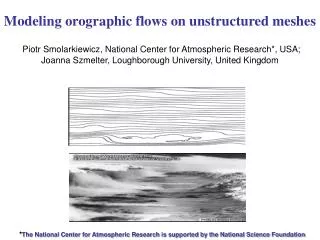
Modeling orographic flows on unstructured meshes PiotrSmolarkiewicz, National Center for Atmospheric Research*, USA; Joanna Szmelter, Loughborough University, United Kingdom *The National Center for Atmospheric Research is supported by the National Science Foundation
The twofold aim of this talk: highlight the progress with the development of a nonhydrostatic, soundproof, unstructured-mesh model for atmospheric flows; assess the accuracy of unstructured-mesh discretization relative to established structured-grid methods for orographic flows;
EULAG’s key features(www.mmm.ucar.edu/eulag/) Cloud cover and precipitation over the Alps • A suit of governing PDEs; numerical laboratory • Conservative, nonoscillatory, forward in time (NFT) semi-implicit numerics • Robust elliptic solver; “exact projection” • Static /dynamic grid stretching with 2nd order accuracy Gray and blue volumes denote cloud water and rainfall, respectively.
Unstructured-mesh framework for atmospheric flows Smolarkiewicz Szmelter, pubs in JCP, IJNMF,Comp. Fluids, 2005-2011 • Differential manifolds formulation • Finite-volume NFT numerics with a fully unstructured spatial discretization, heritage of EULAG and its predecessors (A = MPDATA) • Focus (so far) on wave phenomena across a range of scales and Mach, Froude & Rossby numbers
The edge-based discretisation Dual mesh, finite volumes Edges
NonhydrostaticBoussinesq mountain waveSzmelter & Smolarkiewicz , Comp. Fluids, 2011 NL/Uo = 2.4 Comparison with the EULAG’s results and the linear theories (Smith 1979, Durran 2003): 3% in wavelength; 8% in propagation angle; wave amplitude loss 7% over 7 wavelenghts
Soundproof generalizations Smolarkiewicz & Szmelter, Acta Geophysica, 2011 For[anelastic,pseudo-incompressible]:
Non-Boussinesq amplification and breaking of deep stratospheric gravity wave t=1h isothermal reference profiles ; Hθ = 3.5 Hρ NL/Uo ≈ 1 , Fr ≈ 1.6; o = 2 km Hρ A(H/2)=10ho = o t=1.5h EULAG “reference” solution using terrain-following coordinates t=2h Prusa et al., JAS 1996; Smolarkiewicz & Margolin, Atmos. Ocean,1997; Klein, Ann. Rev. Fluid Dyn., 2010
unstructured-mesh “EULAG” solution, using mesh (left) mimicking terrain-following coordinates, and (right) a fully unstructured mesh t=1.5h Pseudo-incmpressible equations (Durran 1989) Anelastic equations (Lipps & Hemler 1982, Lipps 1990)
Hθ Hρ (RE: Achatz et al., JFM, 2010) t=0.75h ln θ
A global hydrostatic sound-proof model M ≡ gh + Isosteric/isopycninc model: = ρ-1 , =p Isentropic model: , (Szmelter & Smolarkiewicz, J. Comput. Phys. 2010)
Stratified (mesoscale) flow past an isolated hill on a reduced planet 4 hours Fr=2 Fr=1 Fr=0.5 Hunt & Snyder J. Fluid Mech. 1980; Smolar. & Rotunno, J. Atmos. Sci. 1989 ; Wedi & Smolar., QJR 2009
h=8-1o Smith, Advances in Geophys 1979; Hunt, Olafsson & Bougeault, QJR 2001
Conclusions: Unstructured-mesh discretization sustains the accuracy of structured-grid discretization and offers full flexibility in spatial resolution. Future atmospheric models may blend structured/unstructured discretization techniques.