Download
1 / 14
150 likes | 275 Views
Learn about drug metabolism reactions, clearance mechanisms, and their impact on dosage regimen optimization in pharmacokinetics. Explore hepatic metabolism, urinary elimination, and phases of drug metabolism. Discover how drug clearance affects steady-state concentration.

E N D
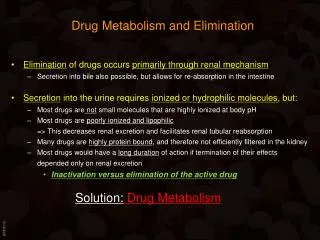
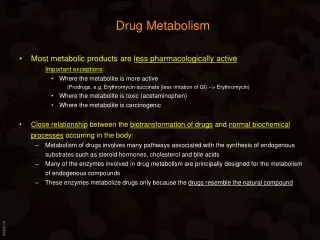
Drug Clearance through Metabolism Zero order kinetics 1st order kinetics • Drugs are eliminated from the body by: • Hepatic metabolism • Elimination in bile • Elimination in urine Clearance (CL): amount of drug removed from body per unit time
Reactions of Drug Metabolism • Phase I • Phase I through P450 • Specificity • Genetic variability • Inducers • Inhibitors (omeprazole, grapefruit) • Phase I not involving P450 • Phase II • Reversal of Order of the Phases
decrease pl D conc • decrease D activity • Decrease therapeutic effect • Decrease therapeutic D effect
Drug Clearance by the Kidney • Glomerular filtration: • ( free D cleared by ???) • Proximal tubular secretion: • (WAs & WBs) • Distal tubular reabsorption: • (lipid soluble Ds)
Clearance (continuation) • Clearance by other Routes • Total Body Clearance • Clinical Situations Resulting in Changes in t1/2
Design & Optimization of Dosage Regimen Steady State Condition (Css) Css is directly proportional to rate of infusion Css is inversely proportional to CL