Kinematic Equations Mastery: Solve Physics Problems Efficiently
290 likes | 419 Views
Master the application of kinematic equations in physics problems. Practice scenarios of objects in motion to solve for time, acceleration, and velocity. Homework assignments provided for practice.


Kinematic Equations Mastery: Solve Physics Problems Efficiently
E N D
Presentation Transcript
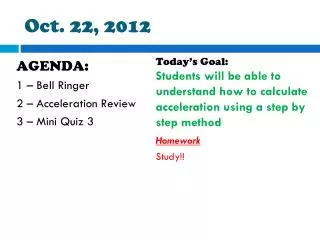
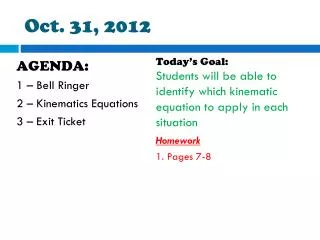
Oct. 31, 2012 AGENDA: 1 – Bell Ringer 2 – Kinematics Equations 3 – Exit Ticket Today’s Goal: Students will be able to identify which kinematic equation to apply in each situation Homework 1. Pages 7-8
CHAMPS for Bell Ringer C – Conversation – No Talking H – Help – RAISE HAND for questions A – Activity – Solve Bell Ringer on binder paper. Homework out on desk M – Materials and Movement – Pen/Pencil, Notebook or Paper P – Participation – Be in assigned seats, work silently S – Success – Get a stamp! I will collect!
October 31st (p. 13) Objective: Students will be able to identify which kinematic equation to apply in each situation Bell Ringer: A car slows from 22 m/s to 3.0 m/s at a constant rate of 2.1 m/s2. How long does it take?
October 31st (p. 13) Objective: Students will be able to identify which kinematic equation to apply in each situation Bell Ringer: A car slows from 22 m/s to 3.0 m/s at a constant rate of 2.1 m/s2. How long does it take?
October 31st (p. 13) Objective: Students will be able to identify which kinematic equation to apply in each situation Bell Ringer: A car slows from 22 m/s to 3.0 m/s at a constant rate of 2.1 m/s2. How long does it take?
October 31st (p. 13) Objective: Students will be able to identify which kinematic equation to apply in each situation Bell Ringer: A car slows from 22 m/s to 3.0 m/s at a constant rate of 2.1 m/s2. How long does it take?
October 31st (p. 13) Objective: Students will be able to identify which kinematic equation to apply in each situation Bell Ringer: A car slows from 22 m/s to 3.0 m/s at a constant rate of 2.1 m/s2. How long does it take?
October 31st (p. 13) Objective: Students will be able to identify which kinematic equation to apply in each situation Bell Ringer: A car slows from 22 m/s to 3.0 m/s at a constant rate of 2.1 m/s2. How long does it take?
October 31st (p. 13) Objective: Students will be able to identify which kinematic equation to apply in each situation Bell Ringer: A car slows from 22 m/s to 3.0 m/s at a constant rate of 2.1 m/s2. How long does it take?
Shout Outs Period 5 – Quantas Period 7 – Treyvon
Oct. 31, 2012 AGENDA: 1 – Bell Ringer 2 – Kinematics Equations 3 – Exit Ticket Today’s Goal: Students will be able to identify which kinematic equation to apply in each situation Homework 1. Pages 7-8
Week 8 Weekly Agenda Monday – Kinematic Equations I Tuesday – Kinematic Equations II Wednesday – Kinematic Equations III Thursday – Review Friday – Review Unit Test next week!
What are equations? Equations are relationships. Equations describe our world. Equations have changed the course of history.
Notes: Kinematic Equations The Four Kinematic Equations: vf = vi + aΔt Δx = viΔt + aΔt2 2 vf2 = vi2 + 2aΔx Δx = (vf + vi)Δt 2
Homework Review (p. 6) 9. A train decreases speed from 30 m/s to 20 m/s while traveling a distance of 250 m. What is the acceleration of the train?
Homework Review (p. 6) 10. A car travels at 25 m/s to the north. It has an acceleration of 2 m/s2 to the south for a duration of twenty seconds. What is the final velocity of the car?
Homework Review (p. 6) 11. A car travels at 25 m/s to the north. It has an acceleration of 2 m/s2 to the south for a duration of twenty seconds. What is the displacement of the car?
Homework Review (p. 6) 12. Calvin tosses a water balloon to Hobbes. As Hobbes is about to catch it the balloon has a speed of 1 m/s. Hobbes catches the balloon, and the balloon experiences an acceleration of -0.5 m/s2 as it comes to rest. How far did Hobbes' hands move back while catching the balloon?