Download
1 / 28
280 likes | 297 Views
Explore the vital role of carbohydrates, including their structure, classification, and significance in human health. Discover the different types of carbohydrates, such as monosaccharides, disaccharides, and polysaccharides, and learn about important compounds like glucose, fructose, and chitin. Gain insights into carbohydrate metabolism and the impact of carbohydrates on the human body.

E N D
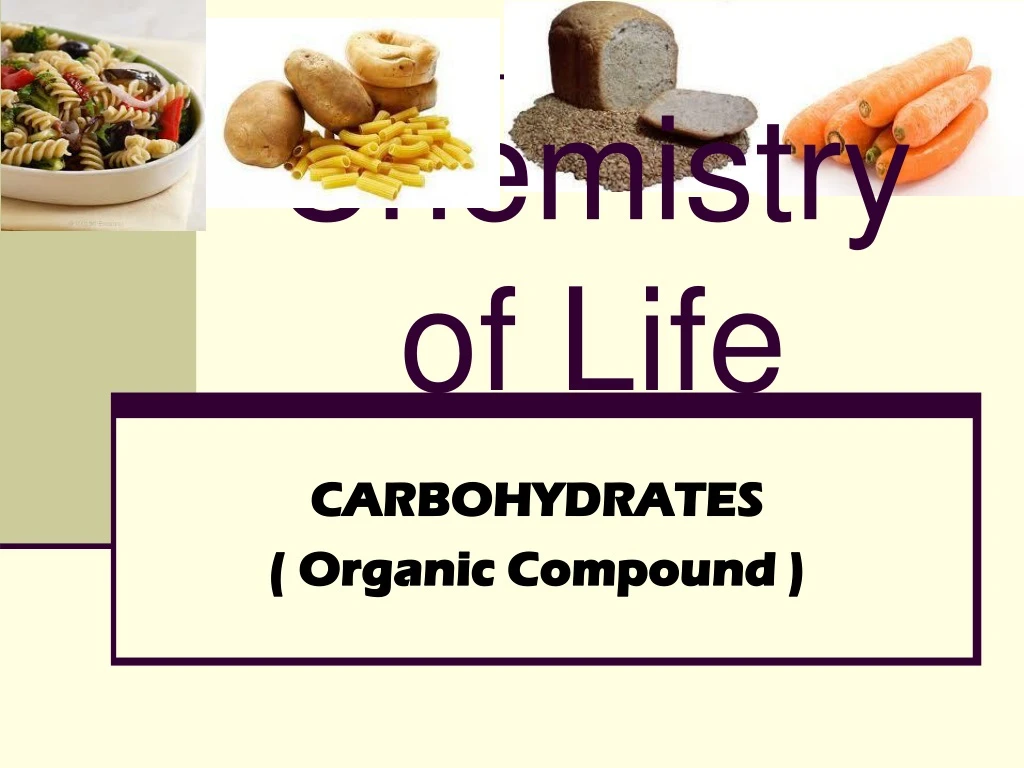
Chemistry of Life CARBOHYDRATES ( Organic Compound )
CARBOHYDRATES • It consist of carbon (C), hydrogen (H), and oxygen (O). • Considered as the chief source of energy. • It includes sugar and starch.
CARBOHYDRATES Monosaccharides are simple sugars with 3 to 7 carbon atoms.
CARBOHYDRATES • Oligosaccharides consist of 2 to 20 monosaccharides. • Polysaccharides consist of tens or hundreds of monosaccharides joined through dehydration synthesis. • Starch, glycogen, dextran, and cellulose are polymers of glucose that are covalently bonded differently. • Chitin is a polymer of two sugars repeating many times. What is Chitin?
CARBOHYDRATES • Disaccharides are formed when two monosaccharides are joined in a dehydration synthesis. • Disaccharides can be broken down by hydrolysis.
Roles of Carbohydrates in the Body • It serve as the backbone of other molecules. • It serves as stored energy . • It is most common source of energy in the body. • It combines with protein to form structural components of living cells.
Classification of Carbohydrates • Monosaccharide - Simple sugars that consist of only one sugar molecule • Disaccharide – composed of two monosaccharide molecules • Polysaccharides – a complex form of carbohydrates that consist of 3 or more monosaccharide molecules
CARBOHYDRATES • Monosaccharide - Glucose - Galactose - Fructose • Disaccharide - Sucrose - Maltose - Lactose • Polysaccharide - starch - Cellulose - glycogen - chitin
MONOSACCHARIDES • Are building blocks of more complex forms of sugars • Common monosaccharide are; - glucose - galactose - fructose • C6H12O6 is the chemical formula of monosaccharides
GLUCOSE • The most common monosaccharide • Known as dextrose or sugar in blood • Its an indispensable component of mammalian (invertebrate & vertebrate) blood • It easily dissolves in water & passes trough cell membrane
GALACTOSE • A part of LACTOSE • Known as milk sugar • C6H12O6 is the chemical formula (same as glucose and fructose) but with different structure
FRUCTOSE • It is the sweetest sugar (10x than lactose) • Known as the corn sugar or fruit sugar • Found in fruits such as atis, melon, and ripe mangoes
DISACCHARIDES • Formed when 2 monosaccharide molecules bond together chemically • C12H22O11 is the chemical formula of double sugar
DEHYDRATION SYSNTHESIS • The removal of water molecule when combining two monosaccharide (simple sugars).
HYDROLYSIS • It is a chemical reaction in which a disaccharide reacts with water to form monosaccharide (simple sugar).
SUCROSE • It is formed when glucose and fructose are combined chemically. • Known as the common table salt. • It is soluble in water but too big to enter the cell.
LACTOSE • Known as milk sugar. • Composed of glucose + galactose, which is synthesized in the mammary gland. • The more lactose a milk contains, the sweeter it is.
MALTOSE • Known as malt sugar • It is a raw material in making beer.
POLYSACCHARIDES • A long chain of simple sugar also known as complex carbohydrates.
STARCH • It is the stored carbohydrate in plants. • It is made up of several glucose.
GLYCOGEN • It is the stored carbohydrates in animals. • It is the source of our reserve energy. • If animals could not store glycogen, they would be eating every minute. • Improper utilization of glycogen will result to genetic ailments and other diseases.
CELLULOSE • It is an insoluble carbohydrates abundant in the wall of plant cells. • It is hard to digest by humans; thus it serves as fiber that provides roughage. • High-fiber diet help reduce the risk of having constipation, hemorrhoids and colon/rectal cancer and can speed up the transit of stool to lower intestine and out of the body.
CHITIN • It is a long, unbrached chain of polysaccharide. • It is the 2nd most abundant organic compound. • It forms part of the exoskeleton of insects, arachnids and crustaceans for their protection.
Side effects of Carbohydrates • Excessive carbohydrates can cause an increase in total caloric intake, causing obesity and pancreatic cancer in women. • Deficient carbohydrates can cause a lack of calories (malnutrition) or excessive intake of fat to make up the calories. • Low-fat, high-carbohydrate diets contribute to hyperinsulinemia and hypertriglyceridemia.