Excretion
Excretion is the body's vital process for eliminating metabolic wastes. Key organs include the lungs, liver, kidneys, and large intestine. The kidneys play a central role in filtering blood, forming urine through three stages: filtration, reabsorption, and secretion. Hormonal controls like aldosterone and ADH regulate blood pressure and fluid balance. Conditions like diabetes and nephritis impact kidney function. Understanding this system is essential for maintaining overall health and managing urinary issues, such as kidney stones and the need for dialysis.

Excretion
E N D
Presentation Transcript
The process by which the body rids itself of metabolic wastes • Lungs eliminate carbon dioxide • Large intestine eliminates toxic digestive waste
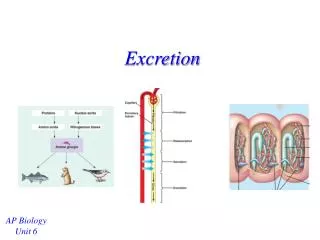
-Ammonia is toxic so it is converted into urea. -Nucleic acids break down into uric acid.
The Urinary System • Two kidneys • Ureters – tubes from kidney to bladder • Bladder – stores urine • Urethra – from bladder to exterior
The Kidneys • Function: to remove metabolic wastes from blood • Also regulate pH and water balance of blood
The Nephron • Microscopic filters – 1 million in each kidney!
Each kidney has 3 regions: • Cortex – outermost • Contains most parts of nephrons
2) The medulla: middle region • Contains loops of Henle, collecting ducts of nephrons
3)The renal pelvis: the mostly hollow innermost region • Collecting ducts merge to form ureter
The Urinary System • Ureters have muscular walls – peristalsis • About 25 cm long
The Urinary System • The urinary bladder – holds up to 600 mL
Urinary System • Urethra is longer in males (20 cm vs. 4 cm)– thus less infections get to bladder
The Urinary System • Micturition: the voluntary release of sphincters controlling the urine output from bladder • Also aided by contraction of bladder wall
Formation of Urine • done by the nephrons • three stages: filtration, absorption and secretion.
Filtration • High blood pressure in the glomerulus forces small molecules out of the blood and into Bowman’s Capsule • Water, ions like Na+, Cl- and H+, amino acids, urea and glucose can pass into Bowman’s capsule
Filtration • Red blood cells, white blood cells and platelets can not move into Bowman’s capsule. • (If they do it is a sign that something is wrong.)
Filtration • About 45 gallons (180 L ) per day passes through Bowman’s capsule. • But only 1-2 L of urine is formed so what happens next?
Reabsorption • Essential nutrients and water are reabsorbed into the blood stream and distributed to the body. • main site: proximal convoluted tubule • also occurs in the loop of Henle, distal tubule and collecting ducts
Reabsorption • Na+ is moved back into the blood by active transport- requires energy • Negative ions like Cl- will follow the Na+ due to charge attraction • Glucose and amino acids are also reabsorbed by active transport
Reabsorption • The movement of solutes back into the blood creates an osmotic gradient so that water also moves into the blood by osmosis.
Secretion Secretion – actively transporting materials back into urine from the blood. Ex) nitrogenous waste, water • Occurs in the proximal and distal tubules.
Proximal tubule secretes H+ which helps maintain pH balance Blood is neutral and H+ makes it acidic so it must be removed. Secretion
Secretion • Other things secreted include ammonia, potassium ions, penicillin, histamines, creatine, etc. Histamine release from a WBC Penicillin capsules
Hormonal Control 1) Aldosteroneis secreted from the cortex of the adrenal glands when blood pressure is low.
Hormonal Control • Low B.P is monitored by kidneys (juxtaglomerular complex)
Hormonal Control • Aldosterone causes the DCT and collecting ducts to increase Na+ transport into blood • Chloride ions and water follow passively
Hormonal Control • Net result: Blood pressure increases and urine output decreases
Hormonal Control 2) Antidiuretic Hormone (ADH) • Produced by hypothalamus, stored in posterior pituitary gland
Hormonal Control • Hypothalamus monitors water content of blood (osmoreceptors) • When the body is dehydrated, ADH is released.
Hormonal Control • ADH makes the nephron more permeable to water so more water is reabsorbed into the blood. • As a result, the urine becomes more concentrated. • When the body is well hydrated, the hypothalamus does not release ADH
Diuretics like alcohol and caffeine inhibit ADH production • So urine output increases
Diabetes Mellitis • inadequate secretion of insulin • without insulin, blood glucose levels are extremely high, and excess glucose remains in the nephron.
The high osmotic gradient prevents water re-absorption and increases urine production. • Sugar is found in the urine
Diabetes Insipidus • lack of ADH production • urine output increases up to 20L/day • no sugar in urine
Nephritis • inflammation of the nephrons • Protein in the urine is a common symptom • The osmotic gradient also causes an increase in urine production. • Nephritis can lead to irreversible kidney damage and eventual kidney failure.
Dialysis Hemodialysis • Artificial kidney machine connects to a vein and pumps blood through semipermeable tubes submerged in a solution to remove waste
Dialysis • Peritoneal dialysis-a catheter is inserted through abdominal lining. • Fluid is injected to collect waste and is drained
Kidney Stones • Crystallized oxalic acid and/or calcium and/or phosphate • Painful!
Kidney Stones Treatment: • Surgical removal • Drugs to dissolve • Lithotripsy-shock waves