Understanding Chemistry: Atoms, Elements, and Reactions
Explore the fascinating world of chemistry with guiding questions like why some things explode while others fizzle out. Learn about atoms, the building blocks of matter, and differentiate between elements, compounds, and mixtures. Discover how atomic structure (such as atomic number and mass number) defines chemical properties. Explore reactions, conditions that speed them up or slow them down, and understand the composition of various substances. Dive into educational resources, including videos and interactive tables to enhance your understanding.

Understanding Chemistry: Atoms, Elements, and Reactions
E N D
Presentation Transcript
GUIDINGQUESTIONS Why do some things go Ka-boom while others just go Pssssss? If I burn something, does it getheavier or lighter? What are the conditions necessary to speed up/slow down a reaction?
Elements and the Periodic Table http://www.privatehand.com/flash/elements.html http://www.youtube.com/watch?v=YIlUXHZR3ZA&feature=related 2
http://www.youtube.com/watch?v=d0zION8xjbM&feature=fvwrel They might be giants
ATOMIC NUMBER and MASS NUMBER Atomic number 6 C Number of protons (+) Mass number 12 Protons + Neutrons
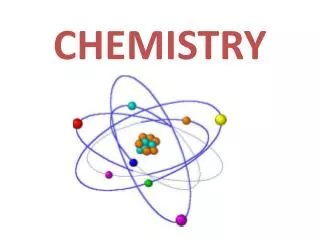
What are atoms? Atoms are the basic building blocks of matter that make up everyday objects. A desk, the air, even you are made up of atoms! There are 90 naturally occurring kinds of atoms.
An element is a substance made up of a single type of tiny particles called atoms.
Protons = Atomic number Protons = Electrons Protons + Neutrons = Mass Number Neutrons = Mass # - Protons
Compoundsare pure substances made of 2 or more elements chemically joined together.
Magnesium Atoms Oxygen Atoms Molecules of magnesium oxide Summary compound element element molecule atom atom
A MIXTURE is a material made up of at least two substances which may be elements or compounds that are NOT chemically bonded .
Properties of Mixtures • The composition of a mixture is variable. • Each of its components retains its characteristic properties. • Its components are easily separated (e.g. filtration, evaporation).
Which are mixtures and which are compounds? • soil • ocean water (H20 + NaCl) • air (O2 + N2 + CO2 + Ar) • water (H2O) • table salt (NaCl) • Sugar (C12H22O12)
http://users.rcn.com/jkimball.ma.ultranet/BiologyPages/M/Mixtures.htmlhttp://users.rcn.com/jkimball.ma.ultranet/BiologyPages/M/Mixtures.html
Source: http://www.google.com.ph/imglanding?q=mixtures+and+compounds&hl=tl&sa=X&biw=1020&bih=567&tbs=isch:1&prmd=ivns&tbnid=hbOgJj5q_O3mEM:&imgrefurl=http://www.teem.org.uk/1060/buy.html&imgurl=http://www.teem.org.uk/img/47/SF1060_3310.jpeg&ei=jj1jTZ3oGcSXcfmHxLsJ&zoom=1&w=500&h=349&iact=rc&oei=QT1jTZTfC4ukugOH0d28AQ&page=1&tbnh=128&tbnw=183&start=0&ndsp=14&ved=1t:429,r:11,s:0
http://www.google.com.ph/imglanding?q=mixtures+and+compounds&hl=tl&sa=X&biw=1020&bih=567&tbs=isch:1&prmd=ivns&tbnid=eet6vXOJz3e-qM:&imgrefurl=http://www.quantumtheatre.co.uk/BDks2web.html&imgurl=http://www.quantumtheatre.co.uk/BDks2web_files/image006.jpg&ei=QT1jTZTfC4ukugOH0d28AQ&zoom=1&w=604&h=292&iact=rc&oei=QT1jTZTfC4ukugOH0d28AQ&page=1&tbnh=90&tbnw=187&start=0&ndsp=14&ved=1t:429,r:4,s:0http://www.google.com.ph/imglanding?q=mixtures+and+compounds&hl=tl&sa=X&biw=1020&bih=567&tbs=isch:1&prmd=ivns&tbnid=eet6vXOJz3e-qM:&imgrefurl=http://www.quantumtheatre.co.uk/BDks2web.html&imgurl=http://www.quantumtheatre.co.uk/BDks2web_files/image006.jpg&ei=QT1jTZTfC4ukugOH0d28AQ&zoom=1&w=604&h=292&iact=rc&oei=QT1jTZTfC4ukugOH0d28AQ&page=1&tbnh=90&tbnw=187&start=0&ndsp=14&ved=1t:429,r:4,s:0