Ideas about Evolution
This chapter explores the definition of a species as a group of organisms that can interbreed and produce fertile offspring, emphasizing that characteristics are inherited from parents. It delves into evolutionary theories, including Lamarck's ideas on acquired characteristics, which have been debunked, and highlights Darwin's contributions regarding natural selection. The chapter also discusses variations, adaptations, and the speed of evolution through gradualism and punctuated equilibrium, including real-world examples like antibiotic resistance.

Ideas about Evolution
E N D
Presentation Transcript
Ideas about Evolution Chapter 6, Section 1
What is a species Again? • Group of organisms that can produce fertile offspring. • Remember, characteristics of a species are passed from parent to offspring.
Evolution • Change in the inherited characteristics of a species.
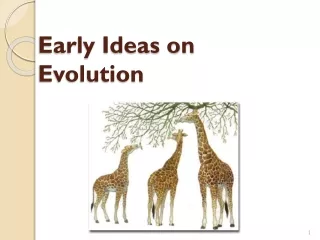
Theory of Acquired Characteristics • Developed by Jean Baptiste de Lamarck in 1809. • States: • Characteristics, or traits, developed in the lifespan of the parent are passed to the offspring. • Has been proven false.
Charles Darwin • Naturalist aboard the HMS Beagle which left England in December of 1831to explore the South American coast, including the Galapagos Islands. • Darwin kept records of the plants and animals encountered during the journey.
Darwin’s Observations • Similar species may develop from a single parent species. • Members of the same population (group of species living in the same area) have to compete for resources in order to survive. • Only those organisms best suited for survival will produce offspring.
Natural Selection • Modern theory of evolution. • Published by Darwin in 1859 in his book, On the Origin of Species. • States: • Organisms with traits best suited for their environment are more likely to survive and reproduce, passing on traits to offspring.
Variation • An inherited trait that makes an individual different from other members of its species. • Result of genetic mutations.
Adaptation • Any variation that makes an organism better suited to its environment.
How can local genes be influenced? • Genes may be brought in or removed by individuals moving into or out of the area. • Geographic Isolation • Group of individuals may be isolated from the rest of the species and develop new traits.
Speed of Evolution • Gradualism • Slow ongoing process in which one species changes to a new species. • Punctuated Equilibrium • Mutation of genes results in the evolution of a new species over a relatively short period of time. • Example: Antibiotic resistance