The Impact of Louis Pasteur on Microbiology and Food Safety
40 likes | 170 Views
Louis Pasteur, while studying why wine soured, uncovered that yeast is responsible for fermentation and bacteria lead to spoilage. This revelation surprised many, demonstrating that bacteria could cause chemical changes. Pasteur advanced the germ theory, suggesting microorganisms can cause diseases. He developed pasteurization—heating liquids to eliminate harmful microbes—leading to safer food and beverages. Today, various pasteurization methods, such as low-temperature holding and ultra-high temperature, are key in food production, ensuring our safety by preventing microbial contamination.


The Impact of Louis Pasteur on Microbiology and Food Safety
E N D
Presentation Transcript
The work of Louis Pasteur Whilst investigating why wine went sour, Pasteur discovered that yeast caused fermentation, and bacteria caused the wine to go off. People found these results surprising, as they didn’t realize that bacteria could cause chemical changes. Pasteur suggested that micro-organisms can cause disease, forming the basis of the germ theory of disease. Pasteur discovered that by heating the grapes to a high temperature before fermentation, the wine did not go sour, as the bacteria had been killed. This technique is called pasteurization.
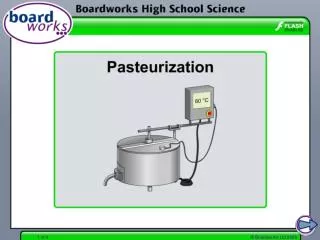
Pasteurization Pasteurization is now widely used in food and drink production to prevent unwanted (and potentially harmful) micro-organisms from growing. There are several different types of pasteurization: • conventional low temperature holding (LTH) – liquid is heated to 60°C for 40 minutes • ultra-high temperature (UHT)– 140 °C for 2 seconds. Pasteurization using a higher temperature will kill off a wider range of micro-organisms. In order to prevent contamination it’s also important that the equipment used at each stage of food production is sterilized.