Wireless Network Architectures for Collaborative Tele-operation
This workshop presentation from ICRA 2004 explores wireless network architectures designed for collaborative tele-operation by networked robots. Dezhen Song and Ken Goldberg from UC Berkeley discuss various robot system taxonomies including Single Operator Single Robot (SOSR), Single Operator Multiple Robots (SOMR), and Multiple Operator Single Robot (MOSR). They present recent advancements in communication technology, analyzing the pros and cons of analog and digital wireless systems, and detailing applications that enhance collaborative robotic endeavors.

Wireless Network Architectures for Collaborative Tele-operation
E N D
Presentation Transcript
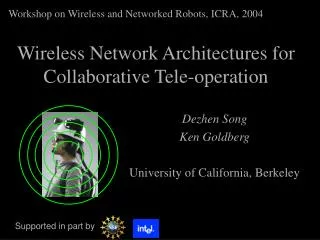
Workshop on Wireless and Networked Robots, ICRA, 2004 Wireless Network Architectures for Collaborative Tele-operation Dezhen Song Ken Goldberg University of California, Berkeley Supported in part by
robot participants remote environment
Robot System Taxonomy (Tanie, Matsuhira, Chong 00) Single Operator, Single Robot (SOSR): Single Operator, Multiple Robot (SOMR): Multiple Operator, Single Robot (MOSR):
Related Work • Recent Networked Robots • Schenker et al. (01) • Goldberg and Siegwart (02) • Coppin, P. and Wagner, M.D. (02) • Konukseven, I., Erkmen, A. et al (02) • Meng et al. (03) • Bicchi et al. (04) • SOSR • Tanie, K., Arai, H. et al. (00) • Lynch, K. and Liu, C. (00) • Fong, T., Thorpe, C., et al(01)
Related Work • SOMR • Hu, Yu, Tsui, Zhou (01) • Jia, Takase (01) • MOMR • Fukuda, Xi, Liu, Elhajj et al. (00,02) • Tanie, Chong, et al. (00) • MOSR • Cinematrix (91) • Cannon, McDonald, et al. (97) • Goldberg et al. (00, 01, 02, 03)
Multi-Operator Single Robot (MOSR) System Remote Environment Operators
The “Tele-Actor”: Operators Remote Environment
Requirements • Low cost • Omni-directional • Light in weight • Low power consumption • Small in size • Moderate range (>80M)
Analog vs Digital RF Transmitter RF Receiver Digitizer Analog Wireless Transmitter Digitizer Receiver Digital Wireless
System Architecture (2001) Berkeley Remote Site Tele-Actor Server Analog 2.4Ghz Internet Local Director Users Anywhere Tele-Actor
Field Test for Analog Wireless Microcam July 18th, 2001, SF Opera House, 5th Annual Webby Awards
Analog Wireless Summary • Pros • Full motion picture in video transmission • Easy to configure • No noticeable time delay in transmission • Cons • Interfere with 802.11b • Sensitive to noisy • Hard to expand due to peer to peer topology • Only transmit analogy signal • Not flexible in selecting hardware
System Architecture (2002-) Berkeley Remote Site Tele-Actor Server Camera Person Local Director Wireless Network (802.11b) Internet Wireless Basestation Users Tele-Actor Anywhere
Hardware Helmet designed by E. Paulos
802.11b Field Tests Nov. 8 & Dec. 19, 2001, UC Berkeley Micro-fabrication Laboratory Jul. 26, 2002, Michael Eisen's Biotechnology lab at Lawrence Berkeley National Laboratory
802.11b Field Tests • HTTP • VoIP • Videoconferencing Feb 13, 2002, SF Exploratorium
Genetics Laboratory (LBL) November 2002 14 seniors from Galileo High, SF
Summary • 802.11b • Pros • Flexible in network topology • Transmit all types of signals • Widely accepted as standard • Cons • Limited bandwidth • Noticeable time delay in signal • Sensitive to interference (2.4Ghz band is busy.) • Problematic in roaming between networks
Future Dez Song: dzsong@ford.ieor.berkeley.edu Ken Goldberg: goldberg@ieor.berkeley.edu