Download
1 / 22
230 likes | 361 Views
This introduction to geography explores its definition, history, and significance in understanding the world. From the ancient contributions of Ptolemy and Eratosthenes to modern geographical tools like GIS, this overview highlights physical and human geography, emphasizing the relationship between people and their environments. Key concepts such as place, region, scale, space, and connections showcase how geographers analyze spatial distributions. The impact of globalization and local diversity underscores the importance of geographical study in today's interconnected world.

E N D
Thinking Geographically AP Human Geography Parkview High School
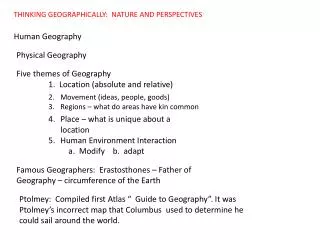
Introduction • What is Geography? • Geography is a representation of the whole known world together with the phenomena which are contained therein • Ptolemy, Geographia, 2nd century A.D. • Definition • Scientific study of the location of people and activities across Earth, and the reasons for their distribution
History v. Geography • Historians • When and why? • Geographers • Where and Why?
2 Factors • Globalization – cultural and economic interaction amongst the world • Local Diversity – cultural traditions and economic practices
Types of Geography • Eratosthenes – first to use geography • Geo = “Earth” Graphy = “to write” • Physical Geography • Where and why natural forces occur • Human Geography • Where and why human activities occur
Example – Hurricane Katrina • Physical Geography • Human Geography
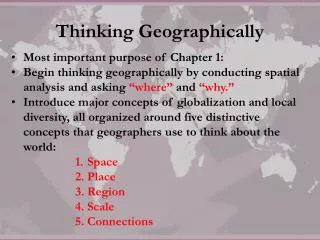
Five Ways to Think About the World • Place • Specific point on Earth distinguished by a particular characteristic • Region • Area of Earth distinguished by a distinctive combination of cultural and physical features • Scale • Relationship between portion of Earth being studied and the Earth as a whole • Space • Physical gap or interval between two objects • Connections • Relationships among people and objects across the barrier of space
Key Issue #1 • How do Geographers Describe Where Things Are?
Maps • Definition: two-dimensional or flat scale model of Earth’s surface • Cartography – science of map making • 2 Purposes • 1. tool for storing reference material • 2. tool for communicating geographic information
Early mapmaking • Earliest surviving maps – clay tablets from Babylon (2300B.C.) • Miletus – port in Turkey – became a center for geographic thought • Ancient Greeks – Aristotle(first to accept that Earth was spherical) and Eratosthenes (map that was within .5% accurate and had climatic zones
Early Mapmaking • Roman Times • Greek Ptolemy traveled the Roman Empire – 8-volume “Guide to Geography” • Codified mapmaking – more fanciful maps • Outside Europe • Phei Hsiu(A.D. 276) – father of Chinese cartography • Ibn-Battutah (1304-1368) 30 years and 75,000 miles of travels – mapped Mediterranean and Asia • Age of Exploration • Columbus & Magellan
Map Scale • 3 Representations • What is Appropriate? • Depends on the information being portrayed • Downtown area – 1:10,000 • State – 1:10,000,000 • World – 1:100,000,000
Projection • Definition – method of transferring locations on Earth’s surface to a flat map • Result of being flat = distortion of some type: shape, distance, relative size and direction • Mercator • Shape distorted very little, direction is constant • Area is grossly distorted toward the Poles • Robinson • Useful for information across the oceans • Land areas are much smaller
U.S. Land Ordinance of 1785 • Western land in early United States divided into townships and ranges • Township – square 6 miles on each side • Divided into 36 square mile sections • Each section divided into 160 acres – then sold to pioneers • Explains – How states, streets, farms etc got their shape and location
Contemporary Tools • Geographic Information Science • Study helping geographers create more accurate and complex maps, can also measure changes • GIS (Geographic Information System) • The computer system that can capture, store, query, analyze, and display geographic data – each type of information is stored as a “layer” • Remote Sensing • The acquisition of the data from satellites • GPS (Global Positioning System) • device used for navigation from aircraft, ships, now common in cars