Download
1 / 31
310 likes | 407 Views
Explore the rich tapestry of Native American cultures, the arrival of Europeans, Aztec dominance, Eastern Woodland cultures, and the impact of trade and disease. Learn about the complexities of West African societies, the beginnings of the slave trade, and the emergence of powerful nation-states in Europe. Follow the voyages of European explorers, the conquests of the conquistadores, and the development of colonial systems in the New World. Uncover the myths and realities of this pivotal era in world history.

E N D
NEW WORLD ENCOUNTERS America: Past and Present Chapter 1
Native American Histories before Conquest • 20,000 years ago—Ice Age “Land Bridge.” • 14,000 years ago--Humans reach southern point of South America. • These Paleo-Indians did not suffer from many communicable diseases
The Environmental Challenge:Food, Climate, and Culture • Native Americans enjoyed an abundant supply of meat • 5,000 years ago-- Agricultural Revolution • Crops include maize, squash, and beans • Shift from nomadic hunting and gathering to permanent villages or large cities
Mysterious Disappearances • Anasazi Culture—Chaco Canyon • Sophisticated irrigation • Well-built roads for transportation • Pueblo “apartment” buildings • Adena and Hopewell Peoples—Ohio Valley • Large ceremonial mounds • Extensive trade network • Cahokia (in Illinois) —Mississippi Valley • Large ceremonial mounds • Far-flung trade network [had evolved from Ohio Valley civilization]
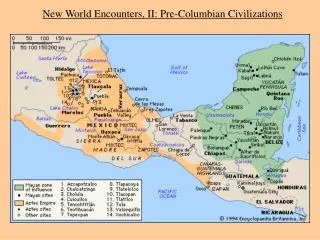
Aztec Dominance • Aztecs settle valley of Mexico • Center of large, powerful empire • Highly organized social and political structure • Rule through fear and force
Eastern Woodland Cultures • Atlantic Coast of North America • Native Americans lived in smaller bands • Agriculture supplemented by hunting and gathering • Likely were the first natives encountered by English settlers • Spoke Algonquian, which included many dialects • Formed confederacies, ie Iroquois League
Locations of Major Indian Groups and Culture Areas in the 1600s
Threats to Survival: • TRADE created a dependency on Europeans, ultimately made Native craftsmanship obsolete. • DISEASE killed millions of Native people, even before Europeans set foot in North America. (smallpox, measles, influenza)
West Africa: Ancient and Complex Societies • Diversity of sub-Saharan Cultures • Islam • Strong traditional beliefs • A history of empires • Mali • Ghana • Daily life centered on elder-ruled clans
Beginnings of theSlave Trade • 15th-century Portuguese chart sea lanes from Europe to sub-Saharan Africa • Native rulers sell prisoners of war to Portuguese as slaves
How Many Slaves? • 17th century--ca. 1,000 Africans per year • 18th century--5.5 million transported to the Americas • By 1860--ca. 11 million • Before 1831, more Africans than Europeans came to the Americas.
Building New Nation-States • Population growth after 1450 • “New Monarchs” forge nations from scattered provinces • Spain • France • England • “Middle class” a new source of revenue • Powerful military forces deployed
Imagining a New World • Spain the first European nation to achieve conditions for successful colonization • Unified under Ferdinand and Isabella • Conquest of Canary Islands provides rehearsal for colonization and for using slave labor.
Myths and Reality • Columbus persuades Queen Isabella to finance westward expedition to “Cathay” • 1492--Initial voyage • Three subsequent voyages to find cities of China • 1506--died clinging to belief he had reached the Orient • Made possible Spanish dominion in America
The Conquistadores • Independent adventurers commissioned by Spanish crown to subdue new lands • By 1512--Major Caribbean islands decimated • By 1521--Cortés destroys Aztec Empire (Moctezuma) • 1539-42--de Soto explores Southeast • 1540-42--Coronado explores Southwest
From Plunder to Settlement • Encomienda System rewards Conquistadors • Large land grants • Indian inhabitants provide labor or tribute • Appointed officials answer only to Crown • Catholic Church • Advocates for Indian rights (Bartolomeo de las Casas) • Performs mass conversions • By 1650, 1/2 million Spaniards in New World • Unmarried males intermarry • Mixed-blood population emerges (mestizo and mulatto)
Portugal • Had turned down Columbus’ proposed expedition in favor of sailing around Africa (very profitably) • Treaty of Tordesillas gave Portugal a large swath of land in South America (Brazil)
The French Claim Canada • Fur trade underpins economy, little settlement of families, etc. • Indians become valued trading partners
The English Enter the Competition • John Cabot (Giovanni Caboto) – 1st recorded transatlantic voyage by an English ship in 1497 • Makes claims of New World territory possible under Henry VIII (r. 1509-1547) • Colonization under Elizabeth would be fueled by a nationalist, anti-Catholic (anti-Spanish) spirit.
Protestantism • Lutheran Reformation • God speaks through Bible, not Pope or priests • Justification by faith alone for salvation • Calvinist Reformation • John Calvin stresses God’s omnipotence • Predestination—some persons chosen by God for salvation • Calvinist Christianity expands in northern Europe • France—Huguenots • Scotland—Presbyterians • England—Puritans
Birth of English Protestantism • English rise influenced by Protestant Reformation • 1517--Martin Luther sparks reform in Germany • 1536--John Calvin’s Institutes published in Geneva • Reformation pits European Protestants against Catholics
The English Reformation • Tudor monarchs bring political unity • Reformation under Henry Vlll (r. 1509-1547) strengthens Crown • Religious “see-saw” under Edward (Prot.), Mary (Catholic), Elizabeth (Prot.)
Elizabeth I • Elizabeth I (1558-1603) a very capable monarch • Elizabeth introduces Via Media • Protestant Doctrine • “Catholic” Ritual • Ends religious turmoil in England • Elizabeth’s excommunication by Pope prompts Spanish crusade against England • England aligned with Protestant nations against Catholic powers
Religion, War, and Nationalism • Spanish hostility makes Elizabeth the symbol of English, Protestant nationhood • Sea Dogs’ seizure of Spanish treasure makes them English heroes • 1588-- Spanish Armada defeated
Irish Rehearsal for American Settlement • English experiences in Ireland shaped how they would conquer the New World • To the English the Irish were wild and barbaric • They would view Native Americans the same way • One way of justifying Irish land grab was the “inefficient” way the Irish farmed. • Brutality fostered long-term resentment.
An Unpromising Beginning: Mystery at Roanoke • Sir Walter Raleigh established Roanoke colony in 1584 • He named the region Virginia after the “Virgin Queen” • The colony failed and Raleigh tried again in 1587 • The colonists disappeared without a trace and their fate remains a mystery
Campaign to Sell America • By 1600 no English settlements in New World • Richard Hakluyt advertises benefits of American colonization • Claimed that England needs American colonies • Book, The Principall Navigations, Voyages, and Discoveries of the English Nation, spurred colonization.
What is ethnocentrism? • Columbian Exchange? • “Age of Discovery” reloaded . . .