Overview of Tomasulo's Algorithm and Operation Latencies in Out-of-Order Execution
This document outlines a series of operations demonstrating how Tomasulo's algorithm handles instruction scheduling and execution. It includes specific load (LD), multiply (MULTI), subtract (SUBD), and division (DIVD) instructions, illustrating their latencies and completion cycles. The content highlights the dynamic renaming of registers in reservation stations, ensuring efficient out-of-order execution. Key cycles detail the completion statuses of operations and their dependencies, showcasing the algorithm's ability to manage resources effectively while minimizing idle times due to data hazards.

Overview of Tomasulo's Algorithm and Operation Latencies in Out-of-Order Execution
E N D
Presentation Transcript
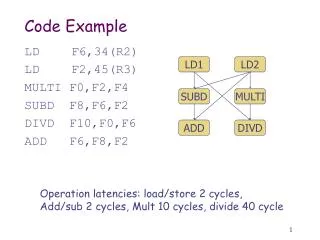
Code Example LD F6,34(R2) LD F2,45(R3) MULTI F0,F2,F4 SUBD F8,F6,F2 DIVD F10,F0,F6 ADD F6,F8,F2 LD1 LD2 SUBD MULTI ADD DIVD Operation latencies: load/store 2 cycles, Add/sub 2 cycles, Mult 10 cycles, divide 40 cycle
Tomasulo Example Cycle 3 • Note: registers names are removed (“renamed”) in Reservation Stations • Load1 completing; what is waiting for Load1?
Tomasulo Example Cycle 4 • Load2 completing; what is waiting for it?
Tomasulo Example Cycle 7 • Add1 completing; what is waiting for it?
Tomasulo Example Cycle 10 • Add2 completing; what is waiting for it?
Tomasulo Example Cycle 11 • Write result of ADDD here vs. scoreboard?
Tomasulo Example Cycle 15 • Mult1 completing; what is waiting for it?
Tomasulo Example Cycle 16 • Note: Just waiting for divide
Tomasulo Example Cycle 56 • Mult 2 completing; what is waiting for it?
Tomasulo Example Cycle 57 • Again, in-oder issue, out-of-order execution, completion