Download
1 / 7
70 likes | 189 Views
This study investigates the group velocity maps of Rayleigh waves at varying periods across Tibet. At short periods, group velocities are notably slow due to a thick, sluggish crust. In contrast, long periods reveal neutral to fast group velocities, attributed to compensation by faster upper mantle materials. The research also examines mantle structure through depth slices, highlighting key geological features such as the Altyn Tagh Fault, Kunlun Fault, and subduction processes affecting both Indian and Asian lithospheres. Insights into mid-crustal anisotropy and the influence of hot asthenospheric material are discussed.

E N D
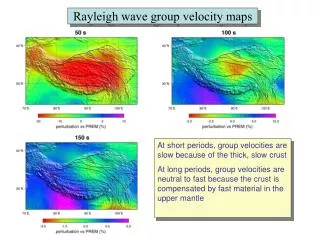
Rayleigh wave group velocity maps At short periods, group velocities are slow because of the thick, slow crust At long periods, group velocities are neutral to fast because the crust is compensated by fast material in the upper mantle
Low-velocity uppermost mantle beneath North-Central Tibet High-velocity material at 200 km beneath most of Tibet Mantle structure:depth slices
Mantle structure:slice across Western Tibet Subduction of Indian lithosphere
Mantle structure:slice across Central Tibet Detached lithosphere
Mantle structure:slice across Eastern Tibet Subduction of Asian lithosphere ???
0 0 0 depth (km) depth (km) depth (km) Altyn Tagh Fault 300 300 300 Jinsha River Suture Kunlun Fault Bangong-Nujiang Suture Yarlung-Zangbo Suture Main Belt Thrust Western Tibet Subduction of the Indian lithosphere Penetration of hot asthenospheric material from the North Strong mid-crustal anisotropy is probably caused by the extended ductile deformation of the crust Central Tibet Lithospheric detachment Penetration of hot asthenospheric material from the North Strong mid-crustal anisotropy is probably caused by the extended ductile deformation of the crust Eastern Tibet Possible subduction of the Asian lithosphere Possible penetration of hot asthenospheric material from the South Mid-crustal anisotropy is weaker than in Western and Central Tibet Interpretation of the tomographic model for Tibetan region