Download
1 / 13
130 likes | 262 Views
The cell division cycle is a finely regulated process essential for growth, reproduction, and tissue renewal. However, when regulatory mechanisms are disrupted, uncontrolled cell division can occur, leading to tumor formation. Key phases of mitosis include prophase, metaphase, anaphase, and telophase, each crucial for ensuring genetic material is accurately duplicated and distributed. Mitosis not only produces two genetically identical nuclei but is also vital in processes such as asexual reproduction, growth, and embryonic development, highlighting its significance in biology.

E N D
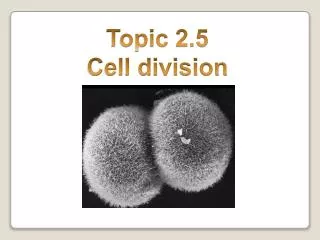
Topic 2.5 Cell division
2.5.2 Uncontrolled cell division: tumour cells The cell division cycle is regulated in a number of ways. Certain agents can damage these regulatory elements. When this happen, uncontrolled cell division can occur resulting in the formation of tumours.
2.5.3 Interphase MITOTIC PHASE S OF INTERPHASE G2 OF INTERPHASE
2.5.4 The phases of Mitosis: Prophase • Chromosomes supercoil and become visible • The spindle of microtubules forms from the MTOC (microtubule organizing centre) • In animal cell, the centrioles divide and move to opposite ends (poles) of the nucleus. • In plant cells, there are no centrioles and the spindle microtubules forms independently. • Each chromosome consists of two chromatids held together by the centromere. • Nuclear envelop breaks down. MTOC (pair centrioles)
2.5.4 The phases of Mitosis: Metaphase Spindlemicrotubules attaches to the chromosomes by means of the centromere. Chromosomes are moved to the equator of the cell,
2.5.4 The phases of Mitosis: Anaphase The pair of sister chromatids separate and the spindle microtubules pull them towards opposite poles of the cell.
2.5.4 The phases of Mitosis: Telophase The chromatids have now reached the poles and can be regarded as distinct chromosomes. The nuclear envelop forms around each group of chromosomes. Chromosomes uncoil The cytoplasm divide by a process called Cytokinesis.
2.5.5 Explain how mitosis produce two genetically identical nuclei
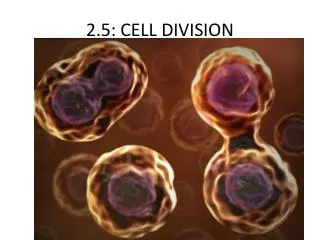
2.5.6 Why do cells divide? Asexual Reproduction Growth & Embryonic Development Tissue Renewal Tissue renewal. This dividing bone marrow cells (arrow) will give rise to new blood cells. Growth & Development. A sand dollar embryo shortly after the fertilized egg divided forming two cells. Reproduction. An ameba, a single-celled eukaryote, is dividing into two cells. Each new cell will be an individual organism