Influence of Music and Celebrities on Brand Perception: A Study of Second-Order Conditioning
This study explores second-order conditioning in marketing, examining how pairing music (CS1) with unpleasant experiences (US) influences consumer perceptions of a fictitious sportswear brand (CS2). Conducted by Blair & Shimp (1992), the research involved subjects listening to theme music during bad weather, revealing negative conditioning effects towards the brand. The findings imply significant associations between music and brand perception, suggesting that carefully selected music can enhance or impede advertising effectiveness. The results highlight the need for brands to consider previously conditioned musical associations in marketing strategies.

Influence of Music and Celebrities on Brand Perception: A Study of Second-Order Conditioning
E N D
Presentation Transcript
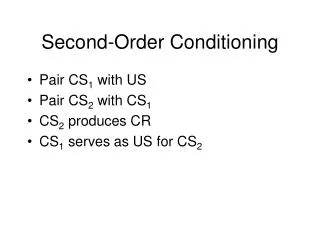
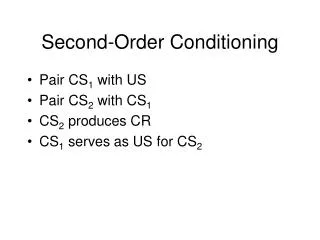
Second-Order Conditioning • Pair CS1 with US • Pair CS2 with CS1 • CS2 produces CR • CS1 serves as US for CS2
Blair & Shimp (1992) • Unpleasant experience paired with music • Brand paired with music
Design • Pre-conditioning phase • Subjects listen to theme music • Sessions during bad weather • Usually, music induces mood, so US • But, here treat music as CS1 and bad weather as US • Conditioning phase • Fictitious sportswear brand paired with theme music • Brand is CS2 • Control group • Random pairing of CS2 and CS1 • Test • Measure affect toward brand
Terminology • Article uses older terminology • Music as US, not CS1
Results • Negative conditioning to brand in pre-conditioning group • Music acquired negative affect • Negative affect transferred to brand
Implications • Music choice in advertising significant • May have previously conditioned connotations • Enhance or impede intended effect • Transfer to brand • Overshadowing effects • Popular music • More salient than brand (ignore CS)
US Pre-exposure • Repeatedly present US • More difficult to subsequently condition CS • US occurs without predictive stimulus
Second Order Classical • US is affective state, mood, etc. • CS1 is celebrity, expert, consumer, or TPO • CS2 is brand
Celebrities • Famous people • Associations • Popular • Rich • Attractive
Experts • Known or unknown • e.g., scientist, doctor, lawyer, mechanic, etc. • Associations • Knowledge • Authorities
“Typical”Consumer • Average shopper • Real or fake • Association • Nothing to gain (leads to trust) • Credibility
Third Party Organizations • Popular in advertising • Independent organizations • Rank, rate, or promote a product • Quality indicators
Effectiveness of TPOs • Work through credibility vector • Indicate quality • TPO won’t want to lose public opinion • Won’t endorse a poor product • Good for • Products of high financial value and low psychological risk
Social Learning Theory • Bandura • Observational learning • Attributes of model and learner
Model Rewardingness Authority Dominance Similarity Sincerity Learner Uncertainty Age Sex Characteristics
Operant • Observe • Reinforcement or punishment • Imitate with expectation • Generalized imitation
Attractiveness • Important for • Celebrity endorsers • Less important (but not ignored) for • Experts, typical consumers
Attractiveness • Can act as US itself • Innate predispositions • Evolved • Health, genotype • Evolutionary psychology • Mating, social interactions
Nature vs. Nurture Debate • Is attractiveness/beauty learned or innate? • Until early 1980s, common consensus was learned • Langlois and collegues • Infant gaze studies • Tips to innate predispositions (with subsequent learning)
Attractiveness as US • With actors and celebrities, usually attractive • Both the recognition of the individual and association with specific traits • Innate attractiveness • Consider • Antonio Banderas • Danny DeVito www.banderas-mall.com/ http://en.wikipedia.org/wiki/ Image:Danny_DeVito_2008.jpg
Cognitive Factor • Attention and recall • Celebrities, experts • Associated with specific aspect of product • Athlete with sports car (fast) • Ex-drug addict with anti-drug campaign (credibility)
Appropriateness • Any celebrity/expert for any product? • Achieving a match • Changes in celebrity/expert’s status? • e.g., O.J. Simpson, Michael Jackson, Kobe Bryant, Madonna, Kate Moss, etc. • Associated with brand • Change in brand status? • e.g., tobacco
Ohanian (1991) • Attractiveness, expertise, and trustworthiness • Use of product • For self or for gift • Male or female consumer
Fictitious Pairings • Celebrities and products • Madonna and designer jeans • John McEnroe and tennis rackets • Tom Selleck and men’s cologne • Linda Evans and perfume en.wikipedia.org/wiki/Image:Madonna-Material-Girl-333295.jpg espn.go.com/classic/biography/s/McEnroe_John.html tomselleck.tv-website.com/ www.geocities.com/lindaevans9/
Questionnaires • Section 1 • Familiarity with celebrity? • Demographic information • Section 2 • Credibility scale • Section 3 • Subject’s likeliness to purchase product • For self or for gift
Subjects • Residential neighborhoods • Churches • Graduate and undergraduate students
Results • Age and gender • No significant impact on evaluation of celebrities’ attractiveness, trustworthiness, or expertise • Nor on likelihood to purchase a product promoted by the celebrity
Celebrity Differences • John McEnroe • Least attractive and trustworthy • High levels of perceived expertise with sports gear • Linda Evans • High attractiveness and trustworthiness ratings • Only average perceived expertise with perfume
Celebrity Attractiveness and Trustworthiness • Generally perceived as important by advertisers, but: • Minimal impact on subjects’ intention to purchase product • Most celebrities are attractive; minimal range, so no differentiation • Celebrities are paid for their endorsements, so not perceived as trustworthy • Expertise the determinant of intention to purchase
Conclusions • To be useful celebrity spokespersons should be • Knowledgeable • Experienced • Qualified to endorse the product
Celebrity • Virgin • Christina Aguilera • Virgin mobile phone • UK release • The devil makes work for idle thumbs. Keep yours busy. Text Virgin Mobile for 3P.
Celebrity • Commodore Vic 20 • Priceline • William Shatner • From playing on Star Trek status to playing on Shatner status
Celebrity • Independence Air • Dennis Miller • Comedian • Started SNL in 1980s • Currently, talk radio show • Endorses conservative opinions, supports Republican candidates, pro military action
Celebrity • 7/11 • S.H.E. • Selina Ren, Hebe Tian, Ella Chen • Taiwanese girl band • 10 albums, $4.5 million sales since 2001, multiple TV roles
Celebrity • Power drink • Arnold Schwarzenegger • Japanese commercial • Sometimes celebrity does cross cultures…but the ad might not
Expert • Nike • Tiger Woods • Use the product, be like the expert
Expert • Chesterfields • Opinion of a physician • Trusted
(Anti-) Expert • BT information technology • Gordon Ramsay • Area of specialization
Expert • Ask an expert • Future Shop • Spoofing use of experts in ads
Typical Consumer • Tide • Moroccan commercial, 1993
Typical Consumer • Salem's cigarettes • Supposedly average couple • Note music score • Gives performance information
Co-Branding • Higher order conditioning association • Two brands are deliberately paired • Favourable attitude to second brand due to positive attitude to first brand • MI
+ + BMW Z3 Sony Mini Disk Sales increase No benefit Does it Work? • Well… sometimes
Prior Associations • First brand should be: familiar, popular • Coca-Cola • Celebrities, characters, Olympics, concepts, music, even colour • Not an ideal co-branding candidate • Change the context • Present familiar brand in different context, causing increased attention & processing
Belongingness • See Rescorla & Furrow (1977); classic study on 2nd order stimulus similarity increasing learning rate • Similar to product-model match • Need to find some way to link two brands • Worked: Bill Cosby and Jello • Failed: Bill Cosby and E.F. Hutton
Similarity • Too much similarity can work against brand • E.g., see Rescorla & Gillan (1980), exp. 2 • Mistake other brands for co-brand • Salem cigarettes • Freshness positioning • Other brands followed this • Consumers made association to more familiar Salem ads, benefiting Salem
Bidirectional? • Associative conditioning could work both ways • Familiar brand (CS1) can be influenced by targeted brand (CS2) • Negative affect from targeted brand • Greater attention paid to familiar brand; more processing • Erosion (additional associations weaken those initially created)
Changing CS1 Post 2nd Order Conditioning • Rescorla (1973), Holland & Rescorla (1975a,b) • 2nd order conditioning • Tone & light as CSs, food as US • Devalue US via satiation or rapid rotation; extinction of CS1 • Reduced CR for CS1 but not for CS2 • Subsequently restoring US returns some CR for CS1 (not a repairing of CS1-US here)
Brand Counterfeiting • Illegally made products resembling genuine product • Traditionally lower quality • Starting to shift for some counterfeits • Outsourced factories run extra “fake” shift • Sometimes shifts counterfeiters into legitimacy • Becoming a serious problem • Over $600 billion in sales
Types • Deceptive • Consumer unaware product is fake • Nondeceptive • Consumer is aware product is fake • Especially prevalent in luxury brand markets