Understanding Instruction Pipelining and Branch Prediction Techniques
180 likes | 372 Views
Explore the intricacies of instruction pipelining, a crucial technique for enhancing CPU performance. This article outlines the stages of pipelining, including fetching, decoding, executing, and writing results, while also addressing the challenges posed by branches in the pipeline. Learn about effective strategies such as branch prediction, loop buffers, and prefetching branch targets. Delve into multiple streams and the significance of managing pipelines to avoid contention issues. Understand how techniques like delayed branching and historical prediction can optimize execution flow in complex programming scenarios.


Understanding Instruction Pipelining and Branch Prediction Techniques
E N D
Presentation Transcript
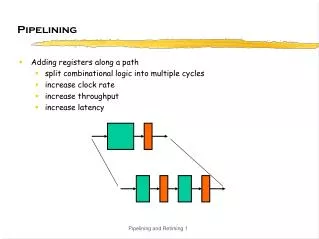
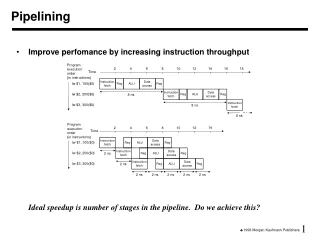
Pipelining • Fetch instruction • Decode instruction • Calculate operands (i.e. EAs) • Fetch operands • Execute instructions • Write result • Overlap these operations
Dealing with Branches • Multiple Streams • Prefetch Branch Target • Loop buffer • Branch prediction • Delayed branching
Multiple Streams • Have two pipelines • Prefetch each branch into a separate pipeline • Use appropriate pipeline • Leads to bus & register contention • Multiple branches lead to further pipelines being needed
Prefetch Branch Target • Target of branch is prefetched in addition to instructions following branch • Keep target until branch is executed • Used by IBM 360/91
Loop Buffer • Very fast memory • Maintained by fetch stage of pipeline • Check buffer before fetching from memory • Very good for small loops or jumps • c.f. cache • Used by CRAY-1
Branch Prediction (1) • Predict never taken • Assume that jump will not happen • Always fetch next instruction • 68020 & VAX 11/780 • VAX will not prefetch after branch if a page fault would result (O/S v CPU design) • Predict always taken • Assume that jump will happen • Always fetch target instruction
Branch Prediction (2) • Predict by Opcode • Some instructions are more likely to result in a jump than thers • Can get up to 75% success • Taken/Not taken switch • Based on previous history • Good for loops
Branch Prediction (3) • Delayed Branch • Do not take jump until you have to • Rearrange instructions