Download
1 / 12
120 likes | 224 Views
This study investigates the origin and characteristics of seismic noise, emphasizing the importance of scattering in wave propagation. By analyzing correlations in water wave motion and conducting controlled laboratory experiments, we explore the nuances of average sea wave height across seasons. Utilizing the SPAC method and applying principles from the 2D scalar case of elastic mediums, we detail how wave illumination impacts the understanding of seismic signals. This research aims to bridge the gap between theoretical models and practical applications in seismology, improving noise detection and interpretation.

E N D
Apparent origin of the noise Average sea wave height winter summer
Importance of scattering: a simple laboratory experiment with a few sources C(A,X) Correlations in water G(A,X) travel time A Xs sources receivers Correlations in presence of scattering
x3 x θ y n x1 ψ THE 2D SCALAR CASE H(2)n(kr)=Jn(kr) − iYn(kr) Illumination by plane waves Azimuthal average over ψ leads to SPAC method k C
Keiiti Aki x3 x θ y n x1 ψ A isotropic distribution of plane waves in an homogeneous body : the local approach THE 2D SCALAR CASE SH waves in a homogeneous elastic medium Propagation takes place in the x1-x3 plane. Therefore, the antiplane (out-of-plane) displacement v(x,t) fulfils the wave equation where β = shear wave velocity and t = time. A typical harmonic, homogeneous plane wave can be written as where, F(ω, ψ) = complex waveform, ω=circular frequency, xT = (x1, x3) = Cartesian coordinates x1= r cosθ = , x3 = r sinθ = , with r,θ = polar coordinates nj = direction cosines (n1= cos ψ , n3 = sin ψ ) Consider the auto-correlation of the motion, evaluated at positions x and y, respectively. For simplicity assume y at the origin: .
Cross-correlations of seismic noise: ANMO - CCM (from Shapiro and Campillo, GRL, 2004) 30 days of vertical motion Dispersion analysis global model by Ritzwoller et al. 2002
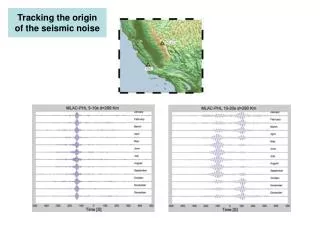
correlations computed over four different three-week periods PHL - MLAC 290 km band- passed 15 - 30 s band- passed 5 - 10 s repetitive measurements provide uncertainty estimations
t G/2 (Re) (Im, Re) t (Im) Causality