Download
1 / 16
170 likes | 319 Views
At Ecole Élémentaire Lucie Aubrac in Sainte-Savine, France, we are excited to present to you the remarkable composer Maurice Ravel, renowned for his extraordinary melodies and orchestral textures. This event includes a special focus on the traverse flute, an instrument with a rich history dating back to the Middle Ages. Notable works by Ravel, such as "Boléro" and "Daphnis and Chloé," showcase his genius. Our students will also perform using simpler flutes, including Beethoven's hymn from the 9th Symphony, promoting peace through the arts.

E N D
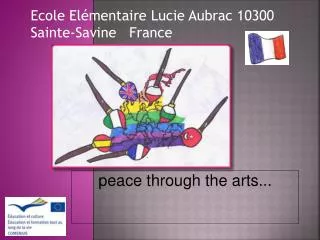
Ecole Elémentaire Lucie Aubrac 10300 Sainte-Savine France peacethrough the arts...
We are going to present you a composer of classical music Maurice Ravel
and a musical instrument: the traverse flute.
Maurice Ravel (March 7, 1875 – December 28, 1937) was a French composer known especially for his melodies, orchestral and instrumental textures and effects.
Ravel is perhaps known best for his orchestral music and arrangement . • Daphnis and Chloé • -Pictures at an exhibition
One of our pupils is playing traverse flute and we decided to now more about it
The traverse flute would have appeared in China, then in West in the Middle Ages (XIIth century). The first descriptions of the instrument date however only of the XVIth century. In the second half of the XVIIth century, Jean-Baptiste Lully introduces the traverse flute into the orchestra of opera and since the XVIIIth century, the instrument sees assigning an important function of soloist. LULLY
The first major transformations brought to the traverse flute will be due to the French family Hotteterre, during the first half of the XVIIIth century. Jacques Martin Hotteterre cuts the flute in 3 pieces .
Children played the European hymn From the 9th symphony of beethoven
The end peacethrough the arts...