Exploring World Religions: Mapping Cultural and Geographical Connections
This interactive activity encourages students to identify countries where major world religions are practiced, including Islam, Catholicism, Protestantism, Judaism, Hinduism, and Buddhism. Students will brainstorm and map these religions across various geographical regions, fostering a deeper understanding of cultural and global connections. The activity aligns with the NCSS themes of understanding historical roots and global interdependence. Afterward, students will reflect on their findings and discuss any surprising insights or misconceptions, enhancing their learning experience.

Exploring World Religions: Mapping Cultural and Geographical Connections
E N D
Presentation Transcript
World Religions Map Activity Chelsea Layton Drew Mines
Just Do It • Brainstorm as many countries as possible in which each of the following religions is practiced by the majority… Go! • Islam • Catholicism • Protestantism • Judaism • Hinduism • Buddhism
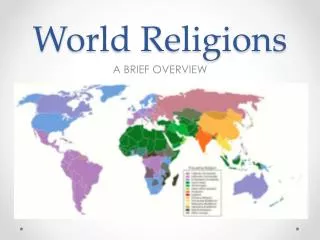
Big Question • Which geographical regions are major world religions located in?
NCSS Themes and SOLs • NCSS: • II. Time, Continuity, and Change. Human beings seek to understand their historical roots and to locate themselves in time… • IX. Global Connections. The realities of global interdependence require understanding the increasingly important and diverse global connections… • SOLs: • WG.3 The student will apply the concept of a region • WG.4 The student will locate and analyze physical, economic, and cultural characteristics of world religions: Latin American and the Caribbean, Europe, United States and Canada, North Africa and Southwest Asia, Sub-Saharan Africa, Russia and Central Asia, South Asia, Southeast Asia, East Asia, Australia and the Pacific Islands, and Antarctica.
Discussion • Were there any differences between your coloring and the religions map? • Were any of the regions harder to locate than others? If so, why do you think that was the case?
That’s a Wrap! • Based on our discussion, write an exit slip with three main ideas that you learned today. • Try and pick things that surprised you or changed any misconceptions you had!