Understanding Photosynthesis: Energy Transformation in Plants
410 likes | 580 Views
This chapter explores the essential process of photosynthesis, the conversion of light energy, water, and carbon dioxide into glucose and oxygen. We will discuss the roles of autotrophs and heterotrophs, the significance of ATP (adenosine triphosphate) in energy storage and transfer, and the structure and function of chloroplasts. Learn about light-dependent and light-independent reactions, including the Calvin cycle, and understand how plants utilize sunlight to produce energy necessary for growth and development.


Understanding Photosynthesis: Energy Transformation in Plants
E N D
Presentation Transcript
Photosynthesis Chapter 8
Interest Grabber Section 8-1 Saving for a Rainy Day • Suppose you earned extra money by having a part-time job. At first, you might be tempted to spend all of the money, but then you decide to open a bank account. • 1. What are the benefits of having a bank account? • 2. What do you have to do if you need some of this money? • 3. What might your body do when it has more energy than it needs to carry out its activities? • 4. What does your body do when it needs energy?
Section Outline Section 8-1 • I. Energy and Life A. Autotrophs and Heterotrophs • Chemical Energy and ATP (adenosine triphosphate) 1. principal chemical compound used in cells to store and release energy
ATP Section 8-1 Adenine Ribose 3 Phosphate groups
2. Energy is primarily stored at ATP 3. To release energy the chemical bond between the second and third phosphate groups is broken producing ADP (adenosine diphosphate)
Figure 8-3 Comparison of ADP and ATP to a Battery Section 8-1 ADP ATP Energy Energy Adenosine diphosphate (ADP) + Phosphate Adenosine triphosphate (ATP) Partially charged battery Fully charged battery
Figure 8-3 Comparison of ADP and ATP to a Battery Section 8-1 ADP ATP Energy Energy Adenosine diphosphate (ADP) + Phosphate Adenosine triphosphate (ATP) Partially charged battery Fully charged battery
Video 1 ATP Formation Video 1 • Click the image to play the video segment.
C. Using Biochemical Energy • 1. ATP is used for: • a. active transport of ions • b. synthesis of proteins and nucleic acids • c. respond to chemical signals on the cell surface • ATP is not good for storing large amounts of energy long term
3. One glucose molecule stores 90 times more chemical energy than one molecule of ATP • 4. Cells can regenerate ATP from ADP as needed by using glucose
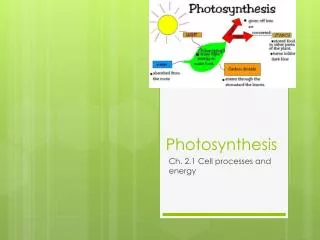
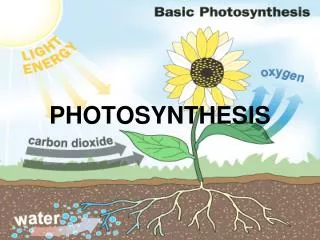
Section Outline Section 8-2 • Photosynthesis: An Overview • A. Photosynthesis – the conversion of light energy, water, and carbon dioxide into high-energy carbohydrate (ie – glucose)
Photosynthesis: Reactants and Products Section 8-2 Light Energy Chloroplast CO2 + H2O Sugars + O2
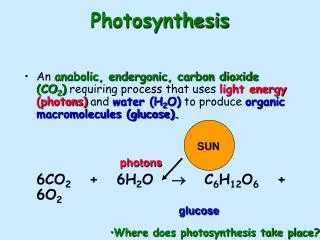
Photosynthesis Equation • Carbon dioxide + water sugars + oxygen • 6CO2 + 6H2O C6H12O6 + 6O2 light light
Video 2 Photosynthesis Video 2 • Click the image to play the video segment.
C. Light and Pigments • Photosynthesis also requires light and chlorophyll • Pigments • a. light absorbing molecules • b. Gather the sun’s energy • Chlorophyll • a. Principal pigment used by plants • b. Chlorophyll a and chlorophyll b • 4. Carotenoids
Absorption of Light by Chlorophyll a and Chlorophyll b Chlorophyll b Chlorophyll a G V B O Y R
Section Outline Section 8-3 • The Reactions of Photosynthesis • Photosynthsis takes place inside chloroplasts • 1. thylakoids • a. Saclike photosynthetic membranes • b. Light collecting units of the chloroplasts
2. stroma • a. Space outside the thylakoid membranes • b. Light independent reactions or Calvin cycle occurs here
Light-Dependent Reactions • 1. require light • 2. produce oxygen gas • 3. convert ADP and NADP+ into energy carries ATP and NADPH
Video 3 Light-Dependent Reactions, Part 1 Video 3 • Click the image to play the video segment.
Video 4 Light-Dependent Reactions, Part 2 Video 4 • Click the image to play the video segment.
Light-Independent Reactions/Calvin Cycle • 1. uses ATP and NADPH from the light-dependent reactions to produce high-energy sugars • 2. the ATP and NADPH formed by the light-dependent reactions contain a large amount of unstable chemical energy • 3. the Calvin Cycle turns this energy into a stable form that can be stored for a long time
Video 5 Calvin Cycle Video 5 • Click the image to play the video segment.
Light- dependent reactions Concept Map Section 8-3 Photosynthesis includes takes place in uses use take place in to produce to produce of
Light- dependent reactions Calvin cycle Concept Map Section 8-3 Photosynthesis includes takes place in uses use take place in to produce to produce of
Light- dependent reactions Calvin cycle Energy from sunlight Concept Map Section 8-3 Photosynthesis includes takes place in uses use take place in to produce to produce of
Light- dependent reactions Calvin cycle Energy from sunlight ATP Concept Map Section 8-3 Photosynthesis includes takes place in uses use take place in to produce to produce of
Light- dependent reactions Calvin cycle Energy from sunlight ATP NADPH Concept Map Section 8-3 Photosynthesis includes takes place in uses use take place in to produce to produce of
Light- dependent reactions Calvin cycle Energy from sunlight ATP NADPH O2 Concept Map Section 8-3 Photosynthesis includes takes place in uses use take place in to produce to produce of
Light- dependent reactions Calvin cycle Energy from sunlight Thylakoid membranes ATP NADPH O2 Concept Map Section 8-3 Photosynthesis includes takes place in uses use take place in to produce to produce of
Light- dependent reactions Calvin cycle Energy from sunlight Thylakoid membranes ATP NADPH O2 Chloroplasts Concept Map Section 8-3 Photosynthesis includes takes place in uses use take place in to produce to produce of
Light- dependent reactions Calvin cycle Energy from sunlight Thylakoid membranes Stroma ATP NADPH O2 Chloroplasts Concept Map Section 8-3 Photosynthesis includes takes place in uses use take place in to produce to produce of
Light- dependent reactions Calvin cycle Energy from sunlight Thylakoid membranes ATP Stroma ATP NADPH O2 Chloroplasts Concept Map Section 8-3 Photosynthesis includes takes place in uses use take place in to produce to produce of
Light- dependent reactions Calvin cycle Energy from sunlight Thylakoid membranes ATP Stroma NADPH ATP NADPH O2 Chloroplasts Concept Map Section 8-3 Photosynthesis includes takes place in uses use take place in to produce to produce of
Light- dependent reactions Calvin cycle Energy from sunlight Thylakoid membranes ATP Stroma NADPH High-energy sugars ATP NADPH O2 Chloroplasts Concept Map Section 8-3 Photosynthesis includes takes place in uses use take place in to produce to produce of
Light CO2 Sugars O2 Figure 8-7 Photosynthesis: An Overview Section 8-3 Chloroplast Chloroplast NADP+ ADP + P Light- Dependent Reactions Calvin Cycle ATP NADPH
Figure 8-10 Light-Dependent Reactions Section 8-3 Hydrogen Ion Movement Chloroplast Photosystem II ATP synthase Inner Thylakoid Space Thylakoid Membrane Stroma Electron Transport Chain Photosystem I ATP Formation
Figure 8-11 Calvin Cycle Section 8-3 CO2 Enters the Cycle Energy Input ChloropIast 5-Carbon Molecules Regenerated 6-Carbon Sugar Produced Sugars and other compounds