Download
1 / 4
40 likes | 135 Views
Explore the Linac-Ring approach to high-energy colliders, pioneered by P. Csonka & J. Rees in 1971 for e+e- ion collisions. Recent projects like ERHIC, ELIC, and T(H)ERA exhibit promise at very high energy levels. Learn about advancements like LHC, CMS, LHC-B, ALICE, ATLAS, QCD Explorer based on LHC and CLIC-1, and QCDE. Discover innovative designs by D. Schulte et al., featuring tailored bunch filling patterns and beam disruption prevention techniques. Stay updated on relaxed CLIC parameters and QCDE adjustments for enhanced performance.

E N D
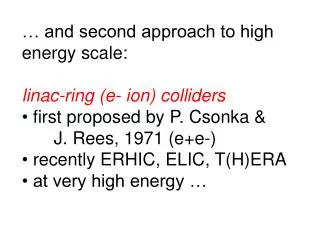
… and second approach to high • energy scale: • linac-ring (e- ion) colliders • first proposed by P. Csonka & • J. Rees, 1971 (e+e-) • recently ERHIC, ELIC, T(H)ERA • at very high energy …
LHC CMS LHC-B ALICE ATLAS QCD Explorer based on LHC and CLIC-1 QCDE CLIC-1
QCD Explorer Colliding LHC with CLIC-1 bunch filling patterns D. Schulte et al., MOPLT039 QCDE IR layout p superbunch tailored to CLIC train length nominal p beam e- beam disruption p beam blow up L>1031 cm-2 s-1 relaxed CLIC parameters xp~0.004 every 111th turn 100 Hz repetition rate